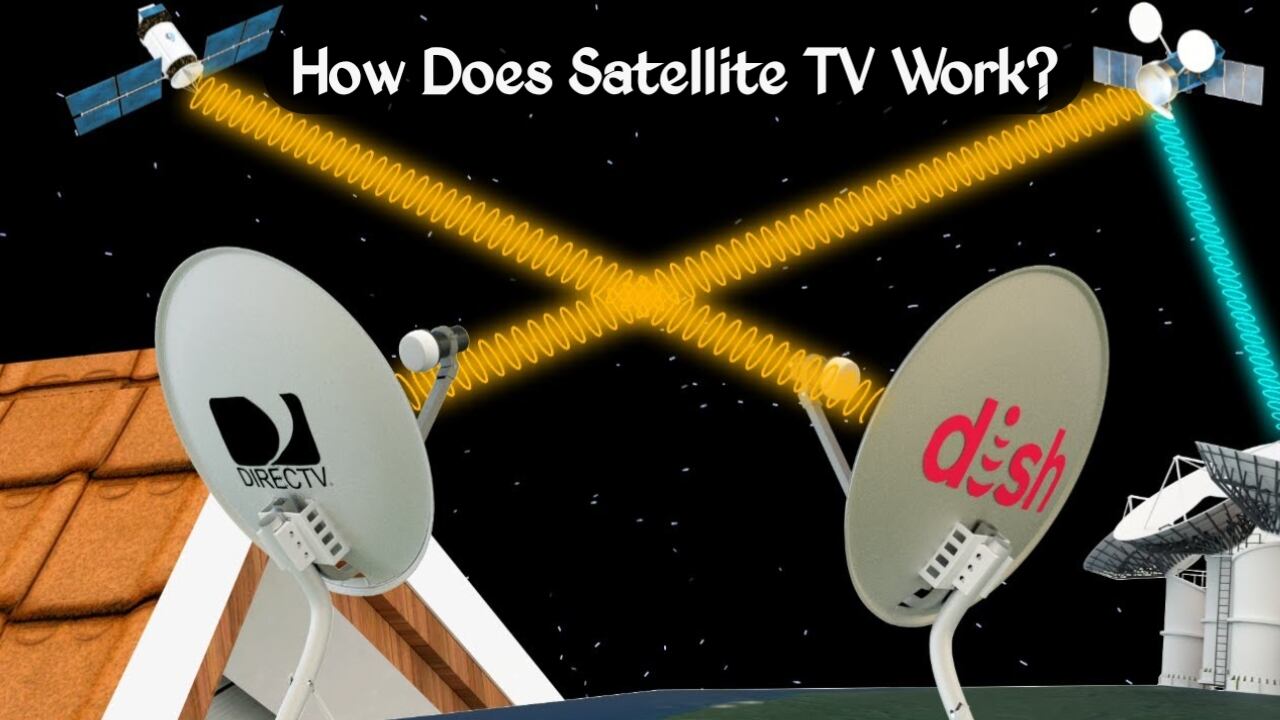
How does satellite TV work? How do TV channels travel from the satellite to your home?
Satellites have significantly changed the way we live. In this article, we will explore how satellite television works and why there is so much money in this broadcasting business. Towards the end, we will also look at why satellite TV broadcasts do not experience buffering, unlike internet videos.
Basic information about satellites to understand satellite TV
To properly understand satellite TV broadcasting, we first need some basic knowledge about the components of a satellite and how they function. As you can see, the Earth revolves around the Sun in an elliptical orbit and also rotates on its own axis. You will notice that this axis of rotation is not perpendicular to the plane of the elliptical orbit but is slightly inclined, as shown. For satellite TV to function, the satellite must not move relative to your home. This means the satellite must orbit at the same speed as the Earth, taking approximately 24 hours to complete one revolution. Let us apply the principles of motion to analyze the balance equation between gravitational and centripetal forces. You can see that the orbital radius required to achieve this state of relative motion is approximately 42,164 kilometers. This orbit is known as the geostationary orbit. Satellites used for satellite TV purposes must be placed in this orbit. This visual illustrates just how crowded the geostationary belt has become these days.
Where does the satellite get its energy
Let us now look at some facts about satellites. Most of the energy required by a satellite comes from its solar panels. However, if the satellite is not facing the Sun, a battery pack helps maintain its operations. It is interesting to note that satellites are equipped with small engines called thrusters. The gravitational field experienced by a satellite is not uniform, due to the influence of the Earth’s surface, the Moon, and the Sun. Thrusters generate small amounts of force to maintain the satellite’s correct orientation and position.
What is a transponder in a satellite
The transponder is the most critical component of a satellite for communication purposes. Transponders receive signals from a base station at a specific frequency, boost the signal power, filter out noise, and re-transmit the signal back to Earth at a different frequency. You will notice that the uplink frequency is always higher than the downlink frequency.
Use of different frequency bands in satellites
You can see antennas designed for various frequency bands. Ku-band frequencies are commonly used for the Ku-band; these signals possess high power, allowing for the use of smaller receiver antennas. In the past, C-band signals—which have lower energy—were used for communication, necessitating the use of large antennas. However, Ku-band signals are susceptible to interference from rain, creating a need for scientists to further improve satellite technology.
How do satellite TV channels reach your home
Now that we have some basic information, let’s look at how hundreds of TV channels reach your home via satellite TV technology.
Consider CNN as an example of a TV channel. CNN has a video production facility and produces content for mass viewing. This 24/7 content is referred to as the “program source.” The channel needs to be available simultaneously on the networks of multiple satellite TV broadcasters, known as DBS (Direct Broadcast Satellite) providers.
How does the TV channel’s signal reach the satellite
To distribute its content, the program source transmits its signal to a leased transponder on a satellite located in geostationary orbit. It is worth noting that before transmitting the video signal, the program source inserts advertisements at appropriate intervals; this serves as the channel’s primary source of income. The CNN signal is typically available at a central point, and any DBS provider can access it after entering into a business agreement with the program source.
How does a DBS provider handle multiple channels
Similarly, a DBS provider collects signals from various channels or program sources. At their broadcast center, they aggregate all this content and perform processes such as MPEG compression, bit-rate standardization, and signal encryption. The DBS provider then transmits the signal to a leased transponder on a satellite. To handle the massive volume of data involved in transmission, a DBS provider leases multiple transponders. This allows a single DBS provider to make approximately 300 to 400 channels available via satellite.
How does the satellite signal reach your home
The final stage of signal transmission involves reaching the end user. The end user must point their dish antenna toward the DBS provider’s satellite. You may have noticed that dishes for different DBS providers require different angles, even when located in the same area; this is because different providers may use different satellites to transmit their signals.
Why is encryption used in satellite TV
The signal is encrypted to prevent unauthorized access or theft of the broadcast received by your dish. After this, it can only be decrypted using the set-top box’s dedicated card. This ensures that only authorized users can watch satellite TV channels.
Why is there a delay in live satellite TV broadcasts
Did you know that the live events you watch on satellite television are actually happening with a delay of a few seconds? Signals leaving the broadcasting center must travel a vast distance via satellite before reaching you. Even though the signal travels at the speed of light, covering such a great distance can cause a delay of approximately 0.5 seconds. A live broadcaster may also introduce an additional delay on top of the standard one.
Why doesn’t satellite TV experience buffering
Now, let’s draw an interesting comparison between internet videos and satellite TV. Both television and internet technologies transmit data in a digital format—as zeros and ones. So, why doesn’t your TV experience the kind of buffering often seen with YouTube or Facebook videos?
With satellite television, a broadcaster provides a limited set of 300 to 400 channels or video streams, and the user simply selects one from this collection.
In contrast, the demands of individual internet users vary widely, and there are millions of videos available to choose from online. This means the volume of traffic managed by TV broadcasters does not even come close to the scale of internet traffic. Internet traffic operates on a massive scale, which can sometimes lead to congestion and buffering.
Conclusion
In this article, we explored the role satellites play in television broadcasting and how hundreds of TV channels reach your home via satellite. The signal travels from the broadcasting center to the satellite, then from the satellite to your dish antenna; finally, the set-top box processes the signal to display the channel on your TV. This is how satellite technology enables us to enjoy television broadcasting services.

I am the founder and content creator of SuperJankari.com, a technology-focused website dedicated to sharing useful information about smartphones, laptops, gadgets, apps, software, and the latest technology updates. My goal is to make technology easy to understand by providing clear, practical, and informative content for readers.