How did VHS and VCRs work? How did an entire movie fit into a small cassette
Take a look at this—a small plastic cassette containing nothing but a thin strip. Yet, it used to hold an entire movie. The most curious thing is that it had no memory card, no hard disk, and no gigabytes of digital storage. So, where did hours of video footage fit inside it? To understand this, we need to step back in time. In those days, there were no home internet packs or YouTube; instead, a bulky machine sat beneath the TV. It was called a VCR—or Video Cassette Recorder. It was a machine capable of both reading the magnetic tape inside the cassette and recording video onto it.
What was VHS
Not all VCRs were the same. One of the most famous formats was VHS. VHS stood for “Video Home System.” It was developed, and VHS-based VCRs were introduced to the world in the 1970s. But let’s set history aside for a moment and address a question: if the cassette contained only a magnetic tape, how did the tape know where specific information was located? The answer lies within the cassette itself.
What was inside the magnetic tape
It wasn’t just an ordinary strip of black plastic; it was coated with an incredibly thin layer of magnetic material. This was the real magic behind the technology. Information was recorded by altering tiny magnetic patterns on the tape. However, this information wasn’t stored in a visual form recognizable to the human eye. In other words, if you opened a VHS cassette and looked at the tape, you wouldn’t see a hero, a scene, or a movie—you would simply see magnetic tape.
How was video converted into magnetic patterns
Video information coming from the TV was first converted into an electrical signal. The VCR would then transform that signal into magnetic patterns—patterns that the same machine could later read back. You can visualize this by imagining a long road marked with thousands of tiny symbols. While you might only see the marks themselves, the machine could interpret the information contained within them. VHS technology recorded information onto magnetic tape in a similar fashion.
How did the tape move inside the VCR
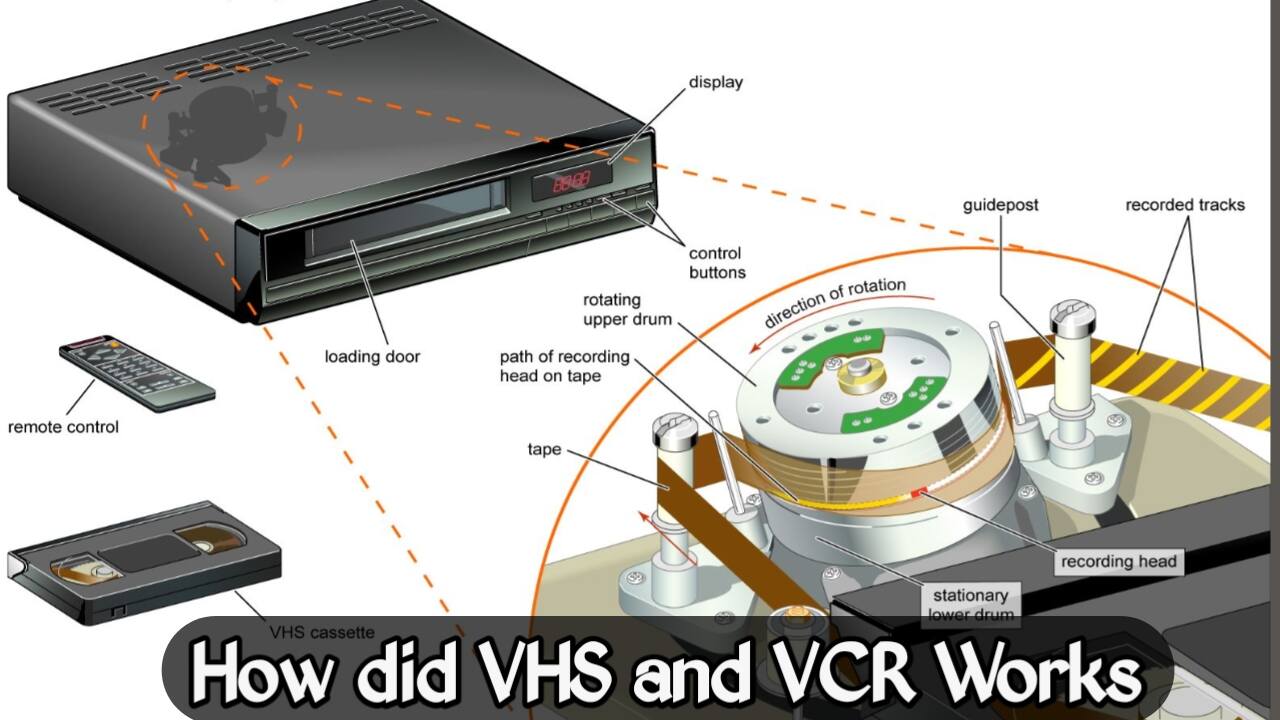
There was another challenge to consider. Given the vast amount of information the tape carried, how was it read inside the VCR? When you inserted a cassette, the machine would pull it inside. However, the tape didn’t simply travel in a straight line from one end to the other; instead, it followed a specific path, wrapping around a rotating drum. This is where the VCR’s true engineering ingenuity came into play.
What was the function of the video head
Inside the VCR, there was a small but crucial component known as the video head. This head would read the magnetic information stored on the tape as it moved. Video data is incredibly dense; reading it slowly using a stationary head would have made handling such a large volume of information difficult. To solve this, the VCR guided the tape around a rotating drum, allowing the video head to sweep across the tape’s surface.
How was video recorded onto the tape
Instead of recording video information in straight lines on the tape, it was recorded in a specific manner using diagonal lines. You can visualize this by imagining a long road marked with diagonal lines rather than straight ones; this is how video information was recorded. This method made it possible to store a large amount of data within a compact space. This was the engineering trick that enabled a small cassette to hold hours of video footage.
How much video could a VHS cassette hold
Early VHS designs allowed for approximately two hours of recording time. This meant an entire movie could be recorded onto a single compact cassette. Consider a scenario where a movie is playing, and its video signal is either reaching your home via a TV broadcast or being written onto the cassette during recording.
How were sound and music recorded
While the concept of the picture is clear, what about the actor’s voice, the music, and the dialogue? To address this, audio information was also recorded onto the VHS tape. Essentially, the cassette contained video information, audio information, and additional data to help the machine synchronize timing—all recorded onto a single, thin strip of tape.
How did the VCR play back the recording
The crucial aspect was that the VCR didn’t just need to record the movie; it also had to play it back later with precise speed and timing. When you pressed the ‘Play’ button, the machine’s motor would start spinning. The tape would move, and the video head would begin reading the magnetic information stored on it. The video head converted this magnetic information into electrical signals. Subsequently, the electronic system transmitted these signals to the TV, allowing the full movie to appear on the screen. This was the core engineering behind the VCR.
Why was timing so critical in a VCR
The VCR needed to know exactly how fast the tape was moving and at what speed the video head was rotating. If the timing was even slightly off, the picture could jitter, shift vertically, or display lines and distortion. That is why motors and control systems inside the VCR constantly regulated the timing. You might recall that with older VCRs, the picture sometimes wouldn’t display correctly, and lines or distortion would appear on the screen. This could happen due to issues with alignment or timing between the tape and the recording.
Why wasn’t the picture quality of old VHS tapes like what we have today
If you have ever watched an old VHS recording, you might have noticed that the picture quality wasn’t as crisp as today’s digital video.
This was because VHS relied entirely on magnetic recording. Over time, the tape could deteriorate, causing the recording quality to drop. Repeated playback could also affect the quality. That is why many old VHS recordings appear slightly blurry or distorted today. There was also a trade-off between recording time and picture quality.
The VCR wasn’t just a movie player
It would be a mistake to view the VCR merely as a movie player; it was also a recorder. If you were watching a program on TV, the VCR could record it onto a cassette. Essentially, for the first time, you were turning your home TV into a recording machine. Once you recorded a program, you could watch it later—the next day, again and again, or—if the cassette was preserved well—even years later. In a way, it was like having a small time machine in your home.
The competition between VHS and Betamax
Another major player at the time was Betamax, a format developed by Sony. This sparked a fierce rivalry between VHS and Betamax, known today as the “VHS vs. Betamax” war. The competition hinged on more than just picture quality; factors like recording time, compatibility, and manufacturing played crucial roles. Gradually, VHS evolved from a simple technology for watching movies at home into a comprehensive system for home video viewing and recording.
VHS preserved cherished home memories
Video recordings, home movies, TV shows, and footage of family functions began to accumulate on these cassettes. VHS tapes eventually became repositories of memories for millions of households worldwide. Weddings, birthdays, family gatherings, or special TV programs—memories of all these events could be recorded on VHS tapes and preserved for years.
So, how did the VHS era come to an end
But technology never stands still. Technologies like CDs, DVDs, file storage, and hard drives emerged, and the use of VHS gradually declined. Today, we can stream entire movies directly from the internet. There was a time when watching a movie required finding a cassette, inserting it into a VCR, and manually rewinding or fast-forwarding it. Today, however, a single button press is all it takes for a movie to start playing on your screen from a server.
What was so special about VHS
Yet, there is something about VHS that still feels special today. Back then, the technology was tangible. You could hold the cassette in your hand, look at it, and hear the sounds it made; you could even watch the mechanical system operating inside the VCR. While watching a movie on TV, you wouldn’t see this internal process—you only saw the picture and heard the sound. Yet, behind the scenes, a magnetic tape, a rotating drum, video heads, motors, and timing systems were all hard at work.
An entire world inside a small cassette
The next time you come across an old VHS cassette, don’t just view it as an old plastic box. Hidden within it was technology that enabled people to watch movies at home, record TV programs, and preserve family memories for the long term. A thin magnetic tape, a rotating drum, small video heads, motors, and timing systems—all combined to create a technology that might seem quite ordinary to us today. The most remarkable aspect was that, while the cassette itself didn’t reveal the movie to the naked eye, it could safely store our memories, recordings, movies, and family moments for years.
Conclusion
The beauty of technology lies in the fact that something may appear simple on the outside while housing extraordinary engineering within. VHS demonstrated how a small cassette could use magnetic technology to record video and audio information and subsequently convert it back into picture and sound. Today, we watch movies via streaming with the push of a button, but there was a time when this same feat was accomplished using a small cassette, a VCR, and the intricate engineering hidden inside them. From the outside, a tiny cassette—but inside, a whole world.

I am the founder and content creator of SuperJankari.com, a technology-focused website dedicated to sharing useful information about smartphones, laptops, gadgets, apps, software, and the latest technology updates. My goal is to make technology easy to understand by providing clear, practical, and informative content for readers.