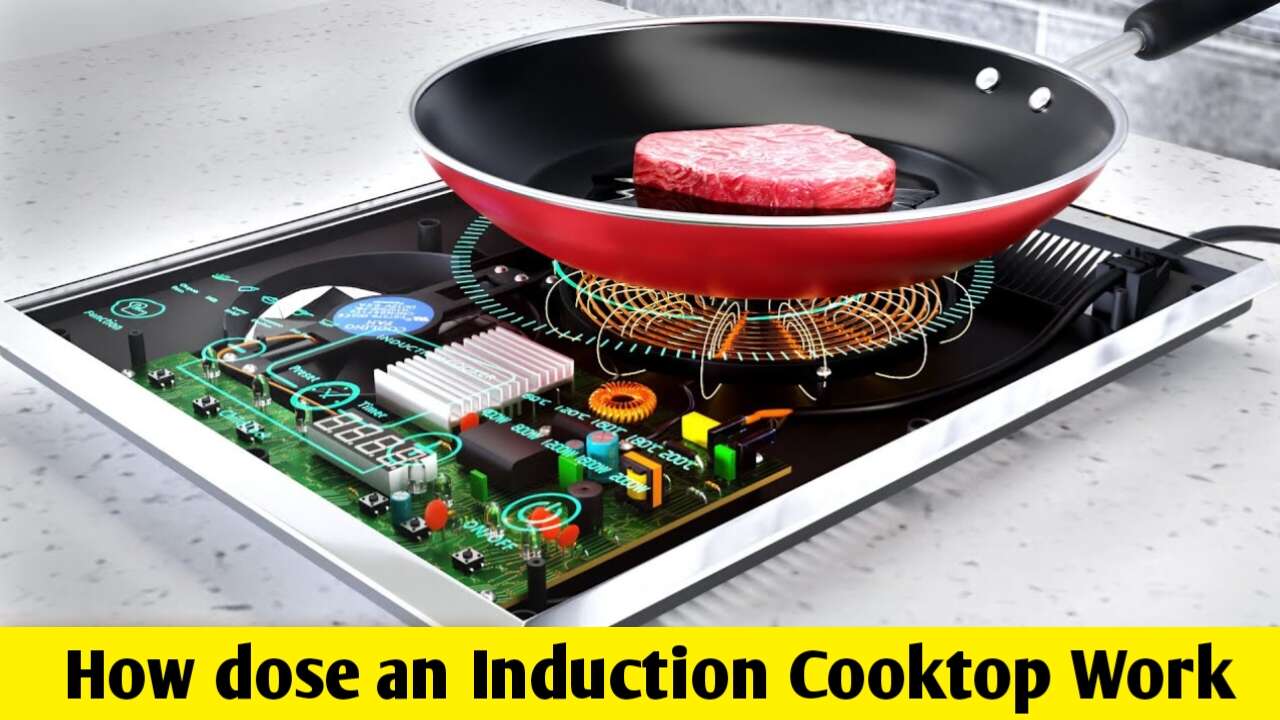
How does an induction cooktop work? Understand the science behind it
Friends, have you ever noticed that the moment you place a vessel on an induction cooktop, it heats up so rapidly that the water inside starts boiling within seconds? Yet, surprisingly, if you touch the cooktop’s surface itself, it doesn’t feel very hot. How is this possible? Is it some form of modern magic, or is there an invisible scientific principle at work—one we cannot see but can certainly experience? You might find it strange to hear that the heat isn’t actually generated on the cooktop’s surface; instead, it is produced directly inside the vessel itself. Yet, that is the true science behind it. Today, we are going to explore the invisible world of induction technology, where electricity, magnetism, frequency, and materials science combine to create a smart cooking system that cooks food without fire, glowing red coils, or direct heat transfer.
How did induction cooking begin
Let’s first step back in time. The story of induction cooking begins in 1831, when the scientist Michael Faraday discovered the principle of electromagnetic induction. He found that if a magnetic field around a conductor is continuously varied, an electric current can be generated within that conductor. At the time, this discovery was merely a revolutionary concept within the realm of physics. No one imagined that this very principle would one day transform the world of kitchen appliances. While it began to be used in transformers and generators, its practical application in cooking became possible only decades later—once power electronics had advanced sufficiently to safely control high-frequency currents. Serious development of induction cooking systems began in the second half of the 20th century, and modern semiconductor technology subsequently made them affordable and efficient.
What is inside an induction cooktop
Let’s explore the inner workings of an induction cooktop. Beneath its surface lies its most crucial component—the copper induction coil. This is a tightly wound coil of copper wire positioned directly under the ceramic or glass surface. When you power on the induction cooktop, the electricity isn’t converted directly into heat; instead, the AC current first reaches this coil. However, the standard household current isn’t used in its raw form. An inverter circuit inside the unit first regulates the current and then converts it into high-frequency alternating current—meaning a current that rapidly and repeatedly changes direction, often cycling between 20,000 and 50,000 times per second.
How is the magnetic field created
As this high-frequency current flows through the copper coil, a rapidly changing magnetic field is generated around it. This magnetic field is the true game-changer for induction technology; while invisible, it is packed with energy. The field remains dormant until a suitable vessel is placed on top. However, the moment you place a vessel made of iron or ferromagnetic steel on the cooktop, the magnetic field penetrates the vessel’s base. According to Faraday’s law, a changing magnetic field induces electric currents within the metal; these are known as eddy currents.
How does the vessel itself heat up
This is where the most interesting part begins. These currents flow in a circular pattern within the metal of the cookware, and the metal’s inherent resistance opposes them. This resistance converts electrical energy into heat. In other words, the coil itself does not heat up; instead, the cookware generates heat within its own body. That is why induction cooking can be described as a “direct vessel heating” technology. Unlike gas stoves, where a significant amount of heat is lost to the surrounding air, induction transfers energy directly to the cookware. Its efficiency can often reach between 85% and 90%.
Why doesn’t every type of cookware work on induction
The question arises: why doesn’t every vessel work on induction? The answer lies in material science. For induction to function correctly, the cookware must be ferromagnetic—meaning it is made of a material that interacts strongly with magnetic fields—such as cast iron or magnetic stainless steel. Materials like aluminum, copper, or glass do not respond to magnetic fields in the same way; consequently, sufficient eddy currents are not generated, and they do not heat up effectively. This is why induction-compatible cookware often features a special magnetic base.
How does the induction surface stay cool
Let’s consider another point: with such a powerful magnetic process taking place, how does the surface remain cool? The answer is that the ceramic glass top serves merely as a support structure, not as the heat source. The induction surface itself generates very little heat; the actual heat is produced at the base of the cookware. However, some heat does transfer to the surface from the vessel via conduction. As a result, the surface may feel slightly warm after cooking, but it does not become dangerously hot like a gas burner. This makes induction cooking comparatively safer.
What is an IGBT
Now, there is another critical component inside the induction cooktop: the IGBT, or Insulated Gate Bipolar Transistor. Essentially, this acts as the induction unit’s high-speed electronic switch. It determines the frequency, duration, and power level at which the current reaches the coil. In simple terms, it serves as the brain and power controller of the induction system. If low heat is required, the IGBT regulates the current pulses; if high heat is needed, it delivers more power. This is precisely what enables induction cooktops to offer such precise temperature control.
The Role of Sensors, Cooling Fans, and Microprocessors
Additionally, temperature sensors, cooling fans, and microprocessors operate continuously within the unit. Sensors monitor the temperature of the cooking surface and the internal electronics. The fan protects internal circuits from overheating, while the microprocessor constantly checks for the presence of a suitable vessel and verifies whether it is properly completing the coil’s magnetic circuit. The system only allows full power output once these conditions are met. This is why induction cooktops are largely protected against accidental heating.
How is Electricity Processed in Induction Cooktops
The operation of an induction cooktop extends beyond just the coil and magnetic field. An intelligent control system works in the background, performing thousands of calculations every second to ensure the heating process is fast, precise, and safe. As soon as you switch on the induction unit, electricity enters the machine via the power cord. However, this electricity does not flow directly to the coil; standard household AC current operates at only 50 or 60 Hz, whereas induction technology requires a much higher frequency. First, the current enters the rectifier circuit, where AC is converted into DC. This DC current then reaches the inverter section, where ultra-fast switching components—such as IGBTs—convert it back into high-frequency AC. However, this time the frequency is thousands of times higher, often exceeding 20 kHz. This high-frequency current is then fed into the copper coil.
What role do frequency and resonance play
This is where the science of frequency becomes crucial. The more optimized the frequency, the more efficient the heating process. Low frequencies can result in weak heating, while excessively high frequencies can destabilize the system. Therefore, engineers design the induction system so that the coil, capacitor, and inverter work together to form a resonant circuit. Think of it like a swing reaching its greatest height when pushed at the right rhythm; similarly, magnetic energy is transferred with maximum efficiency at the correct frequency. This resonance is what makes induction heating fast and efficient.
How does the induction cooktop detect the cookware
As soon as a suitable pan is placed on the surface, the induction sensors detect it. Many people assume that an induction cooktop will heat up anything placed on it, but that is not the case. If you place a plastic plate on it, nothing happens because the system first performs a cookware detection check. It verifies whether the vessel is magnetic, checks if the size is appropriate, and ensures it properly completes the coil’s magnetic circuit. Only then does the system allow full power output. This is why induction cooktops are largely safe from accidental heating.
What is hysteresis loss? Another heating principle in induction is hysteresis loss. In addition to eddy currents, the rapid reversal of magnetic polarity within magnetic metals causes their microscopic magnetic domains to constantly flip, generating heat through internal friction. In other words, both eddy currents and magnetic friction contribute to the heating process in induction. This is precisely why ferromagnetic metals are so effective with induction heating.
Why is induction compared to a transformer
Imagine your cookware effectively becoming an electrical load—not through a wired connection, but via magnetic coupling. This is why induction is often explained using the analogy of a transformer, where the coil acts as the primary winding and the cookware serves as the secondary load. The key difference is that, unlike a traditional transformer, the cookware itself—rather than a second coil—becomes the medium for the induced current.
What safety systems are included in induction cooktops
Regarding safety, induction cooktops feature multiple protection systems. Overheat protection sensors cut off the power if the temperature rises to dangerous levels. However, some cheaper models may generate electromagnetic noise, requiring extra caution for individuals with certain medical implants, such as older pacemakers; that said, modern systems are significantly better shielded.
The Future of Induction Cooking
Looking at the future, induction technology is constantly becoming smarter. Today, many premium induction cooktops come equipped with features like AI-based temperature sensing, pan recognition, zoneless heating, and smart connectivity. Some systems are so advanced that they automatically adjust the power output before the food can burn. In essence, the kitchen of the future could evolve from a mere cooking space into a smart, precision-cooking laboratory.
The Efficiency of Induction Cooktops
An interesting fact is that induction cooking boasts an efficiency of approximately 85% to 90%, whereas traditional gas stoves often manage only 35% to 40% effective heat transfer. This means induction is not just a modern-looking technology; it is a prime example of smart energy utilization. Your food cooks without flames, smoke, or glowing red coils—powered entirely by controlled electromagnetism. And perhaps that is the most beautiful aspect of modern science: the invisible complexity often hidden behind things that appear simple to us.
The Science Behind Induction Cooktops
So, the next time you watch water boil on an induction cooktop, don’t just think of it as cooking. In reality, a host of elements—invisible magnetic fields, high-frequency electronics, eddy currents, hysteresis heating, semiconductor switching, and precision engineering—are working in unison. It is more than just an appliance; it is a scientific narrative that began with Michael Faraday’s 19th-century discoveries and now stands right there on your kitchen counter.
Conclusion
Induction cooktop technology does not require an open flame or glowing heating coils for cooking. It operates through the coordinated functioning of various components, including copper induction coils, high-frequency current, magnetic fields, eddy currents, IGBTs, and sensors. The magnetic field generates heat directly within the cookware, allowing food to cook rapidly. This entire process integrates electricity, magnetism, semiconductor technology, and precision control to create a smart cooking system.

I am the founder and content creator of SuperJankari.com, a technology-focused website dedicated to sharing useful information about smartphones, laptops, gadgets, apps, software, and the latest technology updates. My goal is to make technology easy to understand by providing clear, practical, and informative content for readers.