How does a mobile phone work? Understand the technology inside it
Just think about it: the small mobile phone in your hand isn’t merely a machine; it is a supercomputer made up of millions of transistors. Whenever you send a “Hi” to a friend on WhatsApp, the message reaches their phone—thousands of kilometers away—in less than a second. But how does this actually happen? When you touch the screen just once, how does the mobile know exactly where you touched?
How does the camera recognize that there is a person in front of it
How does the phone convert your voice into electrical signals? And the biggest question of all: what is the very first thing that happens inside the mobile when you press the power button? In this article, we will take a journey inside the mobile phone—a perspective you have likely never seen before. By the end of this article, you will understand exactly how the smartphone in your pocket works.
What exactly is a mobile phone
While a mobile phone might look like a simple device from the outside, internally, it is a complete system comprising several small computers. Every component inside it has a specific function:
The processor (the brain), RAM (temporary memory), storage (permanent memory), the battery (the energy source), the display (the eyes), the touchscreen (the touch-sensing system), and the camera, sensors, speakers, and microphone (representing the ears and voice). All of these are connected by a motherboard, which can be considered the heart of the mobile. Yet, the entire process for all these components begins with just one small power button.
What happens inside the mobile the moment you press the power button
Imagine your phone is completely turned off. You press the power button, and the screen lights up. But the real story begins right then. The moment the power button is pressed, the battery first sends electricity to the motherboard. However, the power doesn’t flow directly to the entire phone; instead, a special chip known as the Power Management IC (PMIC) is the first to activate. It determines exactly how much power should be supplied to each component. If the PMIC fails to function correctly, even a phone worth a fortune becomes completely useless. As soon as it receives the right amount of power, the processor wakes up. However, the processor doesn’t launch Android immediately; first, a small program called the bootloader runs. The bootloader acts as the phone’s security guard, verifying the system’s integrity. Once everything checks out, the Android operating system begins loading into the RAM. Within seconds, the company logo appears, and the phone boots up. In essence, after you press the power button, your phone executes thousands of tiny steps.
How does a mobile processor work
Now, let’s look at the most critical component of a mobile phone: the processor, also known as the CPU (Central Processing Unit). If a mobile phone were a human, the processor would be its brain. Whether you open a calculator, start a game, record a video, or launch YouTube, every command reaches the processor first. The processor performs billions of calculations every second and contains tens of millions of transistors. Transistors are tiny electronic switches that perform these calculations by toggling the flow of electricity on and off. Modern mobile processors are built using incredibly small-scale technology—such as 7-nanometer or 4-nanometer processes. This results in circuits thousands of times smaller than the width of a human hair, yet more powerful than many older computers. But if the processor is so fast, why does the phone sometimes slow down?
What is the function of RAM
This brings us to RAM. Imagine you are reading a book. If you had to walk to a bookshelf every time you wanted to read a new line, the process would take a long time. However, if the book were right there on your table, reading would be much faster. RAM—or Random Access Memory—performs this exact function within a mobile phone. When you open an app, it moves from storage to RAM because RAM is many times faster than storage. This is why apps open quickly and run smoothly without lagging. However, RAM has a specific characteristic: it is temporary memory. As soon as the phone is turned off, all data in the RAM is wiped out; this is why all apps reload after you restart the phone. If RAM is limited, the mobile may frequently close apps, whereas ample RAM allows multiple apps to run simultaneously with ease.
How does mobile storage work
But the question arises: if nothing stays in RAM permanently, where are your photos, videos, and apps stored?
How does storage work
Mobile storage acts like a digital cupboard; this is where your songs, apps, and the entire Android system are saved. Modern smartphones utilize UFS storage, which offers significantly higher speeds, allowing even large games to open in just a few seconds. When you take a photo, the camera first sends the image to the processor; the processor processes it and then saves it permanently to storage. In essence, RAM is a workspace for active tasks, while storage is a place for keeping data.
How does a touchscreen work
Now, the question arises: how do you operate a mobile phone using just your finger, without any physical buttons? How does the phone recognize your finger? In the past, mobile phones had physical buttons, but today, everything is controlled with a simple touch. Capacitive touchscreens feature a very thin, transparent, conductive layer over the screen. When your finger touches the screen, the slight electrical properties of your body alter the sensor’s state. The phone instantly detects exactly where you have touched. This is what enables features like zooming, enlarging photos with two fingers, and performing multi-touch gestures. However, if you have ever tried using your phone while wearing gloves, the touch function often fails to work because standard gloves prevent the electrical signal from reaching the screen.
How does the display create an image
Take a close look at the screen right now. Did you know that the image you see is actually composed of millions of tiny pixels?
Each pixel contains three small color components: Red, Green, and Blue—collectively known as RGB. By varying the brightness of these three colors, the phone can generate millions of distinct hues. If your phone has an AMOLED display, each pixel generates its own light; this results in deep, rich blacks and lower battery consumption. In contrast, an LCD display relies on a backlight that remains constantly illuminated. That is why AMOLED displays are considered superior.
How does a mobile phone battery work
Such an impressive screen can only function if it receives a continuous supply of power. Just imagine: without a battery, even a device packed with cutting-edge technology worth millions would be reduced to nothing more than a useless box. The Lithium-Ion or Lithium-Polymer battery inside a smartphone converts chemical energy into electrical energy. The battery contains two main electrodes—the anode (negative) and the cathode (positive)—with a special chemical substance known as an electrolyte situated between them. When you use your phone, lithium ions move from one side of the battery to the other. This process generates a flow of electrons—an electric current—which reaches the processor, display, camera, and all other components. However, the battery’s power doesn’t go directly to these parts; the Power Management IC (PMIC) acts as an intermediary, supplying the correct voltage and current to each component based on its specific needs.
How does fast charging work
In the past, fully charging a mobile phone took three to four hours, but today, some phones reach near-full charge in just 20–30 minutes.
How is this possible?
The charger and the mobile phone communicate with each other. When you plug in a fast charger, the phone first identifies whether it is indeed a fast charger. If both support the same fast charging protocol, the charger begins delivering higher power. However, the phone continuously monitors the battery’s temperature and voltage; if the battery starts to overheat, the charging speed is automatically reduced. This is why modern smartphones remain safe despite fast charging capabilities.
How does the camera take a photo
Let’s move on to the feature we likely use the most: the camera. When you press the capture button, the lens first directs incoming light into the device. This light falls onto the camera sensor, which contains millions of tiny pixels. Each pixel simply measures the amount of light. The processor and the Image Signal Processor (ISP) combine this data to handle processing tasks like color, brightness, sharpness, and HDR. In other words, the photo you see is the result of the combined efforts of the camera, the processor, and AI. That is why today’s phones can capture stunning photos even at night.
How do speakers and microphones work
When someone calls you, their voice reaches your phone via the internet or a mobile network. However, that voice arrives in the form of digital data. The phone’s speaker converts digital data into electrical signals. Inside the speaker, the voice coil and magnet work together to vibrate a thin diaphragm. These vibrations create sound waves in the air, allowing you to hear the sound. A microphone performs the exact opposite function. When you speak, your voice waves cause the microphone’s thin membrane to vibrate. The microphone converts these vibrations into electrical signals, which are then transformed into digital data and transmitted to the other person.
How does a WhatsApp message reach another phone
But how exactly does your voice or a WhatsApp message travel to another mobile phone thousands of kilometers away?
Have you ever wondered why calls and SMS services stop working if you remove the SIM card from your phone?
In reality, a SIM card is not just a piece of plastic; it contains a tiny microchip. This chip stores your unique identity, allowing the mobile network to recognize that the number belongs to you. As soon as you turn on your phone, the SIM attempts to connect to a nearby mobile tower. The tower verifies your identity, and once confirmed, you gain access to the network. This is why changing the SIM can alter your number and network provider, while the phone itself remains the same.
How does a phone connect to a mobile tower
So, how does a mobile phone communicate with a tower without any wires?
Your phone contains an antenna that transmits and receives radio waves. When you make a call, your voice is first converted into digital data. This data then travels as radio waves to the nearest mobile tower. The tower transmits this data—via fiber-optic cables or other network infrastructure—to the company’s large data center. From there, the data is routed to a tower in another city or country and finally reaches the recipient’s phone. This entire process often takes less than a second.
What is the difference between 4G and 5G
Many people think 5G simply means faster internet, but speed isn’t the only difference. While 4G operates on limited frequency bands, 5G can utilize multiple frequency bands and transmit vast amounts of data simultaneously. This results in faster downloads, smoother video calls, and reduced latency in online gaming. It also allows a greater number of devices to connect to the network at the same time. That is why 5G will play a pivotal role in future technologies like driverless cars, smart cities, and remote surgery.
How does the internet reach your mobile phone
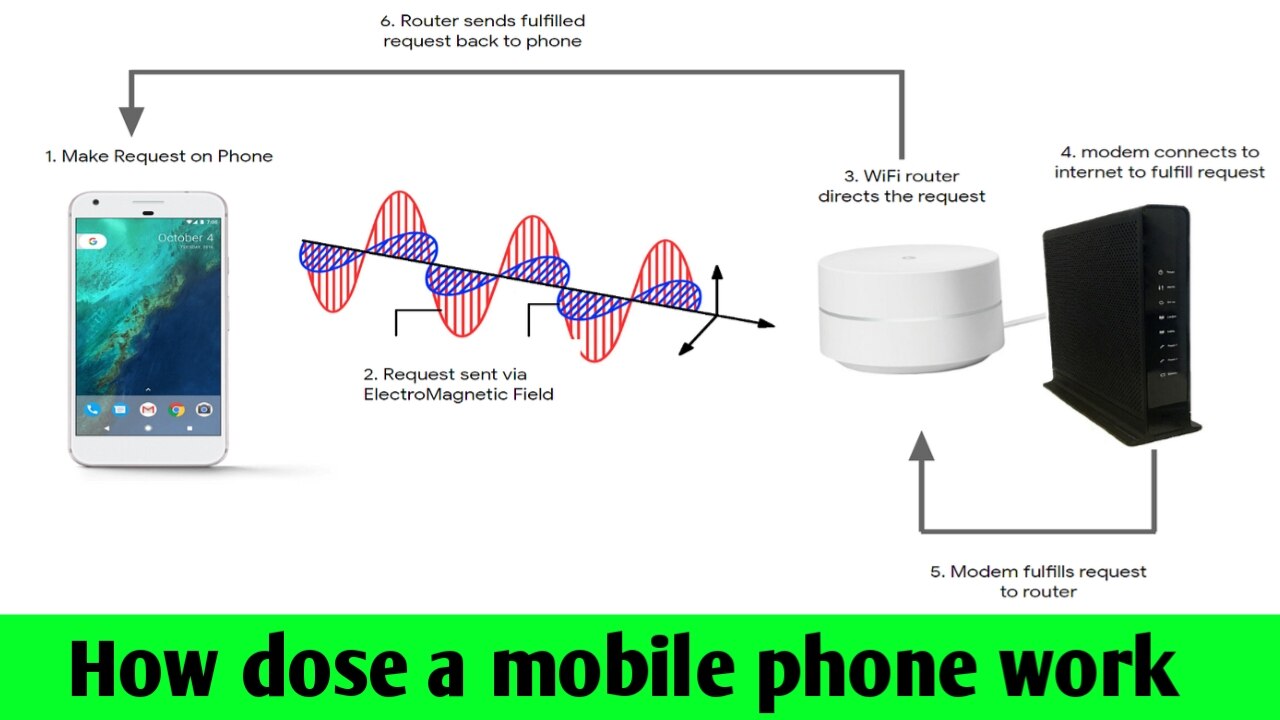
When you open YouTube, the video isn’t already stored on your phone; it resides in a data center somewhere in the world. As soon as you click on a video, your phone sends a request to that server via the internet. The server immediately begins transmitting the video data in small packets. These packets travel to your phone through fiber-optic cables, mobile towers, and radio waves. Your phone reassembles them in the correct order, and the video starts playing within seconds.
How does a WhatsApp message get delivered in a second
Suppose you type just one word—”Bhai” (Brother)—in a WhatsApp message to your friend. As soon as you press the ‘Send’ button, your phone converts the message into small digital data packets. This data then travels via the internet to the WhatsApp server. The server instantly checks whether your friend is online or offline. If they are online, the data is immediately sent to their phone. If they are offline, the server stores the message temporarily; as soon as their phone connects to the internet, the message is delivered. This entire process often takes less than a second.
How does Google Maps determine your location
How does Google Maps know exactly where you are standing?
GPS satellites orbiting the Earth continuously transmit information about their location and time. Your phone receives signals from multiple satellites simultaneously and calculates the time it took for each signal to reach it. Once it receives data from at least four satellites, the phone determines your precise location using a technique called trilateration. This is why navigation is so accurate.
How do smartphone sensors work
Have you ever noticed
The screen rotates when you turn the phone, or it turns off when you hold the phone to your ear during a call. This isn’t magic; it is the work of sensors. The accelerometer detects the phone’s movement and direction, while the gyroscope tracks how much the phone has rotated. The proximity sensor turns off the screen when the phone is brought close to your ear. The ambient light sensor adjusts the screen brightness automatically based on the room’s lighting. The fingerprint sensor unlocks the phone by recognizing your fingerprint. These small sensors are what truly make a smartphone “smart.”
How does AI work in mobile phones
Modern smartphones don’t just follow commands; they also learn. When you open the camera, it recognizes whether the subject is a person, food, a night scene, or a document, and then optimizes the photo accordingly. AI reduces background noise, enhances facial clarity, helps conserve battery life, and optimizes apps based on your usage habits. Features like live translation and voice assistants are also common in today’s smartphones. In essence, a modern smartphone is not merely a phone but a compact computer right in your pocket.
The Technology Inside a Mobile Phone
The next time you pick up your mobile phone, remember that millions of transistors, thousands of electronic components, hundreds of sensors, and millions of lines of software are working together inside it—all so you can connect with the entire world with just a single touch. This small mobile device is truly a marvel of human engineering.
Conclusion
A mobile phone is not merely a simple device; rather, it comprises various components—such as the processor, RAM, storage, battery, display, camera, sensors, microphone, speakers, and network systems—working in unison. From pressing the power button to utilizing features like the internet, calls, WhatsApp, the camera, GPS, and AI, multiple technologies operate together to facilitate every function. It is this collective technology that transforms our compact smartphone into a powerful computer.

I am the founder and content creator of SuperJankari.com, a technology-focused website dedicated to sharing useful information about smartphones, laptops, gadgets, apps, software, and the latest technology updates. My goal is to make technology easy to understand by providing clear, practical, and informative content for readers.