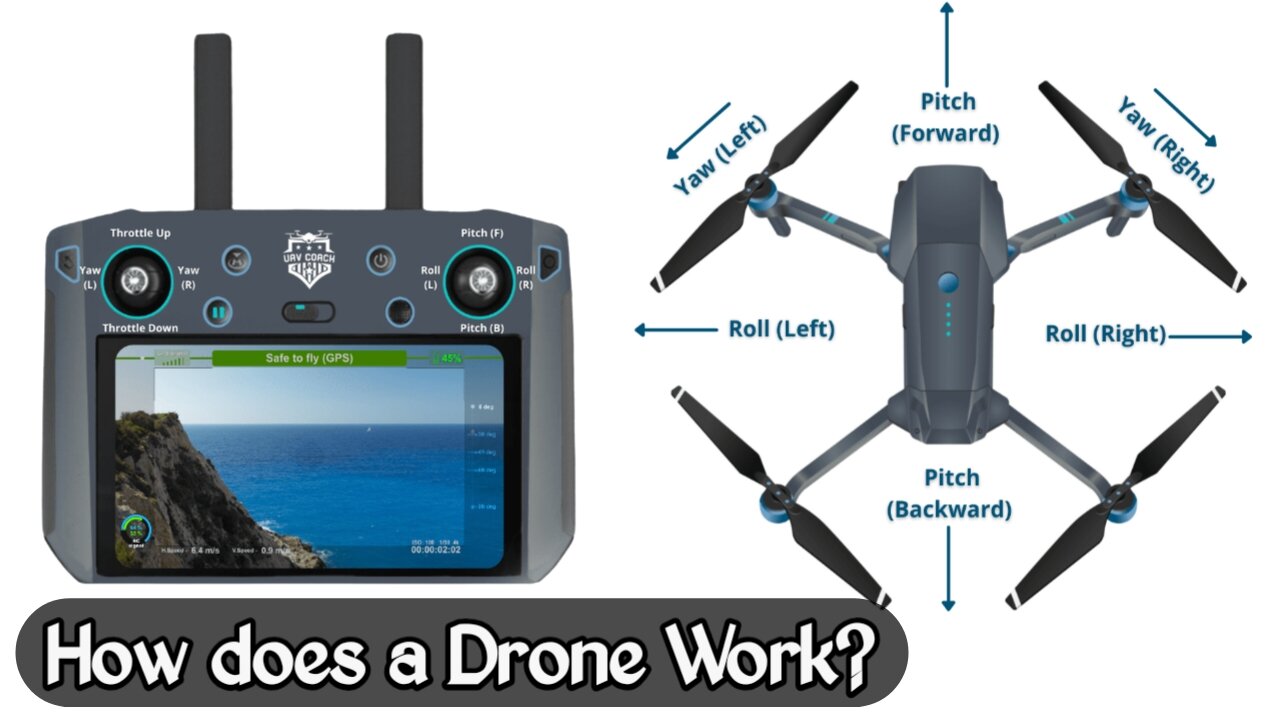
How does a drone work? A comprehensive look at mechanical design, sensors, flight controllers, and GPS.
To understand the mechanical design of a drone—along with its electronic systems, controllers, sensors, intelligent algorithms, and even satellite technology—let us trace the evolution of drone design, starting from the simplest models to modern-day drones.
The simplest drone design
Let us first consider a drone design with a single propeller. While a single-propeller drone can generate enough lift to stay airborne, controlling it is difficult; it can only move vertically up and down. Another major issue is that the drone’s body tends to spin in the direction opposite to the propeller’s rotation. This is a consequence of Newton’s third law of motion. The motor’s stator provides the necessary torque to the rotor; according to Newton’s third law, the rotor exerts an equal and opposite amount of torque back onto the stator. Since the stator is fixed to the drone’s body, this reaction torque causes the drone to spin uncontrollably.
Two-propeller drone
So, why not use two propellers? This is certainly a possibility, and a company named Zero Zero Robotics has made a serious effort to develop such a drone. Fewer propellers mean lower energy consumption, allowing the drone to stay airborne for longer periods. However, the main challenge lies in the fact that high-speed flight, changing direction, and executing sharp turns require a high level of control, accuracy, and stability. We can hope that advancements in control algorithms will one day enable two-propeller drones to achieve excellent stability. In a two-propeller design, the blades rotate in opposite directions; this cancels out the motor’s reaction torque and prevents unwanted body spin.
Three-propeller drone
Three-propeller designs are rarely used. The main challenges associated with this type of drone arise from the motor’s reaction torque and gyroscopic precession. Both these factors introduce unnecessary complexity into the design and control algorithms.
The four-propeller drone: The Quadcopter
The next variation is the four-propeller drone, or quadcopter. Quadcopters typically feature either an H-shaped or X-shaped frame. Let us now understand the dynamics of a quadcopter and how it moves.
How does a quadcopter stay airborne
To achieve a hover, the operator simply needs to ensure that the drone’s weight is balanced by the thrust generated by the propellers. You can also observe the airflow utilized by the propellers to generate the necessary lifting force.
How does the drone move forward
To achieve forward motion, the speed of the front propellers decreases while the rear propellers speed up simultaneously. This causes the drone to pitch. In this state, the vertical component of the propeller force balances the drone’s weight; however, an unbalanced horizontal force is generated, propelling the drone forward.
How does a drone roll
A similar technique is used to control roll movement. Simply put, an imbalance in lift force is created between the left and right pairs of propellers, allowing the drone to roll to one side.
How is reaction torque neutralized in a quadcopter
Earlier in the video, we discussed motor reaction torque and its effect on the drone. To prevent unwanted spinning, one diagonal pair of propellers on the quadcopter rotates in the opposite direction to the other diagonal pair. This technique completely cancels out the reaction torque. However, if you want to rotate the drone, you simply need to ensure that the reaction torque is not fully cancelled. This is easily achieved by reducing the speed of one diagonal pair. Since reaction torque varies with propeller speed, a net reaction torque is generated, allowing the drone to rotate.
Why are quadcopters so popular
Quadcopter drones are easy to control and capable of high speeds and sharp turns. This is why they are used across various fields. Now, let’s look at one of the most critical components of the drone: its “brain.”
The drone’s brain: The Flight Controller
Imagine a drone suddenly encountering a strong gust of wind. The operator would need to control and readjust the speed and rotation direction of every propeller in a split second; otherwise, the drone could crash. It is difficult for a person to manually control the drone in such situations. This is where the most crucial component of the drone comes into play: the Flight Controller. The Flight Controller can be thought of as a tiny, intelligent pilot sitting inside the drone, navigating it through challenging conditions. It allows the operator to use simple controls—such as “forward” or “up”—making drone operation as easy as playing a video game.
Drone Sensors
To achieve this result, the flight controller requires numerous input signals from various sensors. In modern drones, most sensors are very small in size; MEMS technology is employed to manufacture such compact and precise sensors. MEMS are essentially microscopic machines featuring tiny moving parts. Key sensors used in drones include the accelerometer, gyroscope, and magnetometer. These sensors are integrated into an IMU (Inertial Measurement Unit). The IMU is a crucial sensor unit for the drone, as it helps measure the drone’s acceleration and rotation.
How does an accelerometer work
In a MEMS accelerometer sensor, when the drone experiences a force, movement occurs between the tiny internal plates. Capacitance is generated between two plates positioned close to each other; as the distance between the plates changes, the capacitance also varies. This change in capacitance is converted into an electrical signal, which is then transmitted to the controller for processing. A three-axis accelerometer is required to measure acceleration across all three dimensions.
Function of the gyroscope
Incorporating a gyroscope into the IMU allows for the measurement of rotation across different planes alongside force values. This aids in understanding the drone’s orientation and movement.
How is altitude measured
A MEMS-based barometer sensor is used to determine the drone’s altitude. The flight controller or processor must effectively utilize the signals gathered by all these sensors to make accurate decisions.
How is sensor accuracy ensured
The question arises regarding the accuracy of the signals generated by the sensors. Noise, for instance, can compromise sensor accuracy. Potential sources of noise include defective drone propellers, mechanical vibrations, and magnetic interference. To mitigate this issue, modern drones employ techniques such as sensor fusion. For instance, by using a GPS sensor in conjunction with an IMU, a drone’s position and other data can be better understood. Different types of sensors work together to produce more accurate measurements; this process is known as sensor fusion.
The Drone’s Decision-Making System
With accurate signals established, we can now delve into the decision-making aspect of the drone. This falls under the control system, which incorporates control logic—an algorithm designed to minimize errors and make decisions based on the current situation. One such crucial algorithm is the Kalman Filter; it utilizes both past and present data to determine the drone’s state. Such algorithms and logic are also employed in functions like GPS navigation and returning to the “home” location. If a strong gust of wind affects the drone, the control system—relying on sensor data—makes the necessary decisions to stabilize the craft.
How does the flight controller manage BLDC motors
The processor within the flight controller contains components such as logic gates and transistors. It makes intelligent decisions to regulate the speed of the BLDC motors. By independently controlling the speed of each of the four BLDC motors, a quadcopter drone can manage its position and movement across various conditions.
Drone Battery and Communication
The BLDC motors, electronic circuits, antennas, and sensors draw the necessary power from a lithium-ion battery. The drone receives control signals from the user via standard radio frequency technology. For consumer drones, the communication range typically spans one to two kilometers. An interesting question arises here: what happens if the drone accidentally drifts beyond this communication range?
How does a lost drone return
Modern drones can employ GPS and network-based technologies to recover from a lost state. Using GPS, the operator can designate a “home location” before takeoff. Consequently, if the drone moves out of communication range or loses its connection for any other reason, it can initiate a return sequence using its onboard systems and the pre-set home location.
Conclusion
Thus, the evolution of drone design—from simple single-propeller models to modern quadcopters—is a fascinating journey. Along with the drone’s mechanical design, technologies such as propellers, motors, flight controllers, sensors, IMU, sensor fusion, control algorithms, BLDC motors, batteries, communication systems, and GPS work together to enable flight and maintain stability under various conditions. We hope you enjoyed understanding the complete working system of a drone.

I am the founder and content creator of SuperJankari.com, a technology-focused website dedicated to sharing useful information about smartphones, laptops, gadgets, apps, software, and the latest technology updates. My goal is to make technology easy to understand by providing clear, practical, and informative content for readers.