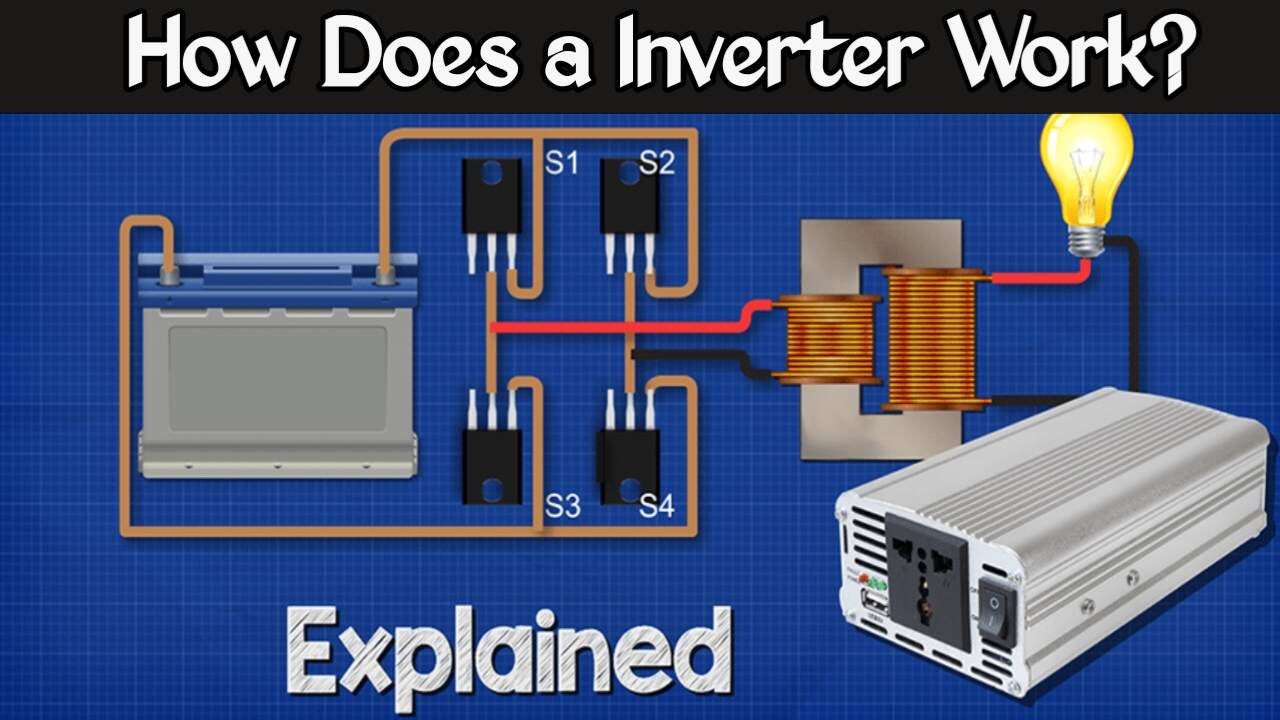
How does an inverter work? How do the lights turn on the moment the power goes out?
Imagine you are studying at night or sleeping comfortably in the breeze of a fan. Suddenly, the power goes out. The room plunges into darkness, but the very next moment—without anyone touching a switch—the lights turn on automatically. The fan starts spinning again. It feels as if someone has waved a magic wand. But this isn’t magic; it is the work of that box mounted on your wall known as an inverter. The question is: how does this box provide electricity when the mains supply is cut off, and how does it know exactly when it is its turn to step in? Today, we will understand the science behind the inverter in simple terms.
Understanding the Inverter
First, let’s clear up a common misconception. Many people think that an inverter generates electricity itself, but the truth is that it doesn’t create power; instead, it converts electricity from one form to another. The real story begins with the battery connected to the inverter. When the mains power is on, the inverter quietly performs one task: it gradually charges the battery, much like how you plug your phone in to charge. In other words, when electricity is available, the inverter stores energy in the battery so it can be used when needed.
How does the inverter know when the power goes out?
The biggest question is: how does the inverter know the moment the power fails that it needs to activate? The answer lies in an electronic sensor and control circuit inside the inverter that constantly monitors the power supply. This circuit continuously checks whether electricity is flowing from the main line. As soon as the power suddenly cuts out, the circuit detects it immediately and signals the inverter that it is time to supply power from the battery. That is why you perceive such a minimal gap between the power going out and coming back on.
How does the battery’s DC power convert into AC?
Let’s understand what happens to the electricity stored inside the battery. The power stored in a battery is DC (Direct Current). However, household appliances like fans, bulbs, and TVs typically run on AC (Alternating Current). If an inverter were to supply the battery’s DC power directly to these appliances, they wouldn’t function properly. This is where the inverter’s most crucial function comes into play. Inside the inverter, there is a specialized electronic circuit that rapidly converts DC current into AC. You can visualize this like a machine repeatedly changing the direction of water flowing in a river to create waves. This process facilitates the conversion of DC to AC, enabling household appliances to operate.
How do we get 220 volts from a 12-volt battery?
Here is another interesting question. The voltage in a battery is usually quite low—around 12 volts—whereas the main power supply in a home operates at approximately 220 volts.
So, how does this small 12-volt supply transform into such a high voltage?
To achieve this, inverters utilize a voltage-boosting circuit and, in many designs, a transformer. Their function is to step up low voltage to a level sufficient to operate household appliances. This is why an inverter is not merely a switch; it performs multiple tasks, such as converting the form of the current, boosting the voltage to the required level, and regulating the power supply.
What does the inverter do when the mains power returns?
Consider what happens when the main power supply is restored: the inverter switches back instantly. It stops drawing power from the battery, and household appliances begin receiving electricity from the mains again. Simultaneously, the inverter resumes charging the battery so it is ready for the next power outage. Essentially, the entire system operates in a continuous cycle:
Charging → Detecting power failure → Supplying power from the battery → Switching to mains supply upon power restoration → Recharging the battery.
Where does the inverter’s true power lie?
Now, here is the most surprising part: the inverter’s true power lies not within the inverter itself, but in the battery. The larger and more suitable the battery’s capacity, the longer the backup power will last during an outage. The inverter acts like a traffic policeman, determining the path, form, and timing of the electricity flow, but the actual energy reservoir is stored within the battery. Thus, the inverter does not perform magic; rather, it relies on the coordinated functioning of various electronic systems.
How many years does an inverter battery last?
The question arises: how long does the battery actually last? In reality, a battery’s lifespan depends on how it is used and the frequency of its charge and discharge cycles. This is known as the “Charge-Discharge Cycle.” A standard lead-acid battery can last for about 3 to 5 years, though its actual lifespan depends on quality, usage, and maintenance. Repeatedly discharging the battery completely can reduce its capacity over time. That is why inverter systems incorporate circuits designed to prevent the battery’s charge from dropping to critically low levels.
What wattage inverter is suitable for a home?
Now, the question arises: what wattage inverter is right for your home? The answer depends on which appliances you wish to run during a power outage—such as fans, a few lights, and perhaps a television. Each appliance has a specific wattage rating, and the total load is calculated by adding these up. The inverter’s capacity is then chosen to be slightly higher than this total load to ensure it isn’t subjected to undue strain when all appliances operate simultaneously. If an inverter with insufficient capacity is used to power heavy appliances like an air conditioner or a water pump, it may overload and shut down because the demand exceeds its rated capacity.
Why do inverters or batteries get hot?
Now, for the question that often sparks a bit of concern: why do inverters or batteries sometimes heat up, and does this pose a danger? Chemical reactions occur inside the battery during charging and discharging, and generating some heat during this process is normal. However, if there is poor ventilation or the battery is placed in a cramped, enclosed space, the heat cannot escape and accumulates internally. This is why it is recommended to place the battery in an open, well-ventilated area. Additionally, high-quality inverter systems often include safety circuits that shut down the system if the temperature rises excessively or other abnormal conditions occur. Therefore, proper placement and correct usage of the inverter and battery are crucial.
Conclusion
By now, you must have understood that an inverter doesn’t perform magic. When mains power is available, it charges the battery; when the power goes out, it detects the situation and supplies power from the battery, converting DC electricity into AC and providing power at the required voltage. It is the combined operation of these processes that ensures darkness is quickly replaced by light the moment the power fails.

I am the founder and content creator of SuperJankari.com, a technology-focused website dedicated to sharing useful information about smartphones, laptops, gadgets, apps, software, and the latest technology updates. My goal is to make technology easy to understand by providing clear, practical, and informative content for readers.