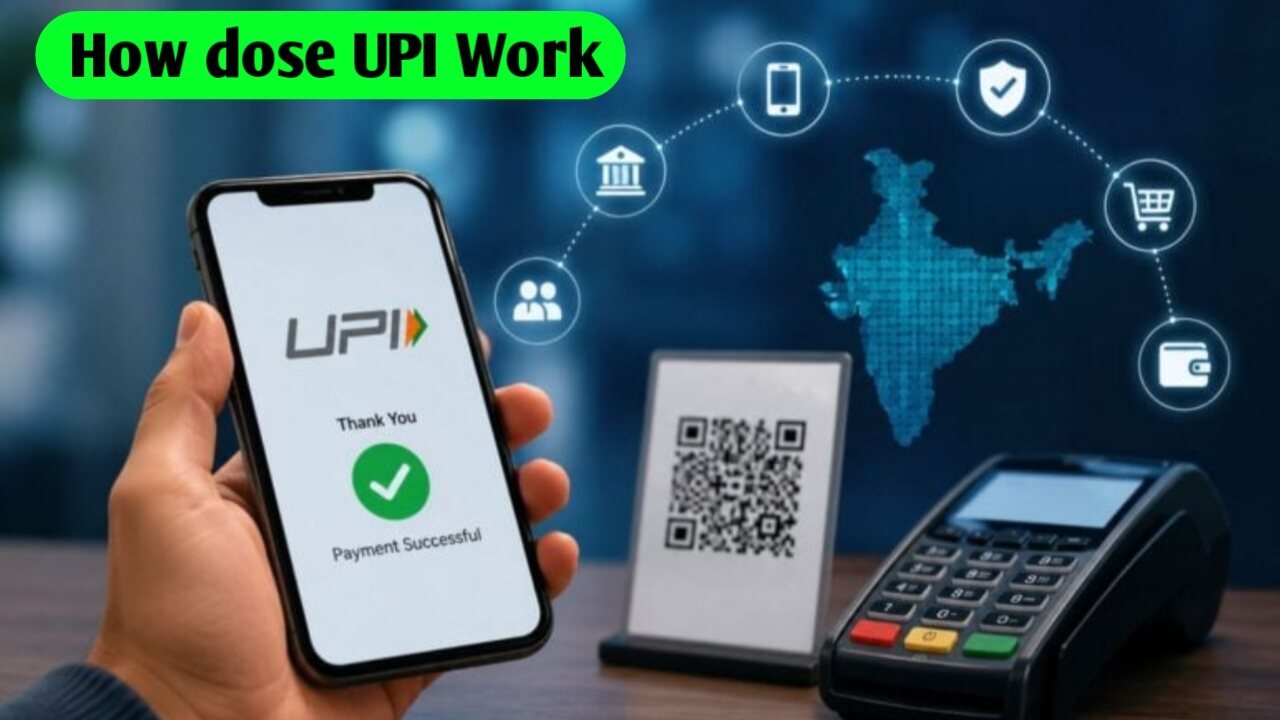
How does UPI work? Understand the technology behind it
Friends, sending money has become so easy these days. You simply open your mobile, launch the UPI app, scan the recipient’s QR code, enter the amount, input your UPI PIN, and within seconds, the money moves from your account to the other person’s bank account. There is no need to count cash, visit a bank branch, or memorize account numbers. But have you ever wondered how UPI works so fast? The money isn’t physically stored inside the phone, yet the payment happens instantly. What is hidden within the QR code? How does the bank know the payment is authentic the moment you enter your UPI PIN? How does the system respond within seconds even when millions of people are making payments simultaneously? Is UPI just an app, or is there an invisible world of banks, NPCI, secure servers, encryption, mobile networks, and real-time routing working behind the scenes? Let’s explore the technology behind UPI that revolutionized the way India makes payments.
What is the basic concept of UPI
First, let’s understand the basic concept of UPI. UPI stands for Unified Payments Interface. It represents a common payment system where various banks and apps connect on a single platform to instantly send and receive money. Previously, sending money involved processes like entering account numbers and IFSC codes, adding beneficiaries, waiting periods, and using services like NEFT or IMPS. UPI simplified this entire journey. Now, there is no need to remember the recipient’s bank details; their UPI ID, mobile number, or QR code is sufficient. In essence, UPI has assigned a simple digital address to your bank account.
What is the actual function of a UPI app
Now, let’s look at the UPI app itself. Apps like PhonePe, Google Pay, Paytm, BHIM, or a bank’s own app act as the “front door” to the system. The actual money resides in your bank account, not in your mobile wallet. The app serves as your interface, facilitating tasks such as initiating requests, scanning QR codes, entering your PIN, and displaying transaction status. When you make a payment via UPI, the app does not transfer the money on its own; instead, it processes the payment by communicating with the NPCI’s UPI network and your bank’s servers.
How is UPI set up?
When you set up UPI for the first time, the app verifies your mobile number. This step is crucial because UPI links your bank account to the specific mobile number registered in the bank’s records. The app confirms the presence of the SIM card in your device by sending an SMS. Next, you select your bank. The system searches for accounts linked to your number, and then you set a UPI PIN using your debit card details or another bank-approved method. This PIN serves as the final authorization for every payment.
What is a UPI ID
Now, let’s understand the UPI ID. Just as an email address consists of a name and a domain, a UPI ID features a unique handle—such as `name@bank` or `mobile@upi`. This ID is not your actual bank account number but rather a Virtual Payment Address (VPA). Its advantage is that you can receive payments without disclosing your account number. When someone sends money to your UPI ID, the system maps that ID to your linked bank account.
What is inside a QR code
Imagine visiting a shop and scanning a QR code. A QR code is a visual code that can encode information such as the merchant’s UPI ID, name, reference details, and sometimes the transaction amount or bill number. Your app reads the pattern via the camera and converts it into text data. If the QR code is dynamic, it includes the exact bill amount and transaction reference. That is why, upon scanning, the app displays the merchant’s name and the amount, allowing you to verify that the money is going to the correct recipient before finalizing the payment. What happens after you enter the UPI PIN?
Next, you confirm the amount and enter your UPI PIN. This is the most critical moment. The UPI PIN is never shared with the merchant, and reliable apps do not store it in plain text on their servers. The PIN entry takes place via a secure process where your authorization reaches the bank in an encrypted format. The UPI PIN acts as the digital key to debit funds from your bank account. If the PIN is incorrect, the bank rejects the transaction; the next step proceeds only if the PIN is correct.
The invisible journey of the payment
Now, the invisible journey of the payment begins. Your app generates a transaction request containing details such as the payer (you), the payee (recipient), the amount, UPI ID, transaction reference, device details, and security data. This request first goes to your app provider or payment service provider bank, and then reaches the NPCI’s UPI switch. Here, the NPCI acts like a traffic controller, routing the request to the correct payer bank and recipient bank. In essence, multiple systems work in a coordinated manner.
How does the bank verify the payment
Now, your bank receives the request.
The bank checks whether:
- Whether the account is active or not.
- Whether the balance is sufficient or not.
- Whether the UPI PIN is correct or not.
- The daily limit hasn’t been exceeded.
- There are no signs of fraud.
- Whether the transaction is allowed or not.
If everything is in order, the bank approves the debit of the amount from your account. Simultaneously, a credit instruction is sent to the receiver’s bank. If any condition fails, the payment is declined; essentially, authorization from the bank’s server is mandatory.
How does the money reach the receiver’s account
What happens at the receiver’s end? As soon as the message is exchanged between the NPCI and the banks, the funds appear as a credit in the receiver’s bank account. Often, this credit reflects instantly, creating the impression that the money simply “flew” across. In reality, the entire process relies on digital ledger entries: a debit entry is created in your bank’s records, and a credit entry is made in the receiver’s bank records. No physical cash changes hands; only the balances within the banking databases are updated.
How does settlement work in UPI
Let’s understand settlement in simple terms. While the payment may appear successful to the customer immediately, the final financial adjustment between banks takes place in the backend via scheduled settlement cycles. In other words, UPI offers a real-time experience on the front end, while banks settle their net obligations in the backend. Every transaction carries a unique reference number, enabling subsequent processes such as complaint handling, reversals, or reconciliation.
Why is UPI so fast
The reasons for this speed are:
- Standardized messaging
- Instant bank connectivity
- Centralized switching
- Secure APIs
- Automation
Older systems relied heavily on manual steps or batch processing, whereas UPI operates on real-time instructions. As soon as a request is sent, bank servers provide an immediate “Yes” or “No” response. Delays in the network, bank server, or app can cause a payment to appear as “pending.” A pending status does not mean the money is lost; it simply means the transaction is awaiting confirmation.
What is a UPI Collect Request
Let’s look at the UPI Collect Request. Sometimes, an individual or a merchant sends you a payment request. You receive an app notification indicating that the sender is requesting a specific amount from you. Money is deducted only if you approve the request and enter your PIN. However, fraudsters can misuse this feature; therefore, one should not approve a Collect Request without fully understanding it. You do not need a PIN to receive money via UPI; the PIN is required only for sending money.
How does UPI security work
Now, let’s discuss security. UPI employs multiple layers of protection, such as mobile number verification, device binding, UPI PIN, encryption, transaction limits, bank risk systems, app authentication, SMS alerts, and fraud monitoring. However, security relies on more than just technology; user awareness is equally important. You should never share your PIN with anyone, be cautious of screen-sharing apps, avoid clicking on unknown links, and steer clear of fake customer care numbers. Also, remember that a PIN is not required to receive payments.
How do banks and companies make money from UPI
The question arises: how do banks and companies earn revenue from UPI? Customers are generally not charged directly for each UPI transaction, which is why people perceive it as a free service. However, the underlying infrastructure does not run for free. Banks, apps, payment service providers, and merchants incur costs related to servers, security, customer support, regulatory compliance, and fraud management. Some earnings come from merchant services, value-added products, loans, insurance, advertising, and business payment solutions. In essence, UPI serves as a gateway to digital finance.
How did UPI transform India
Consider how UPI changed India. Previously, getting change at small shops was a hassle. Auto-rickshaw drivers demanded cash. Online payments seemed complicated, and bank transfers felt intimidating. UPI simplified payments for everything from rent and donations to online shopping. QR codes enabled small merchants to accept digital payments. Customers no longer needed to carry as much cash, and the digital economy gained a new engine.
UPI: Limitations and Precautions
However, UPI is not perfect. Bank servers can go down. Sometimes, an amount is debited but reflects in the receiver’s account with a delay. Money might be sent to the wrong UPI ID, or fraudulent calls might confuse users. Therefore, always verify the receiver’s name during a transaction and enter the amount carefully. If a payment fails, check the status before attempting it again, and keep the transaction ID safe for filing complaints. Technology moves fast, but exercising caution is a human responsibility.
The Future of UPI
UPI is poised for even greater growth in the future. Features like voice payments, payments via feature phones, credit lines on UPI, international UPI links, offline payments, biometric authentication, and merchant tools could make it even more powerful. In the future, UPI will not merely be a method for sending money; it could evolve into a digital layer connecting identity, credit, commerce, and banking services. Just as ATMs made cash access available 24/7, UPI has transformed bank accounts into instant payment machines.
The Technology Behind UPI
So, friends, the next time you make a payment by scanning a QR code via UPI, don’t view it merely as a ‘beep’ or a success screen. Behind the scenes, your mobile number is being verified, and your UPI ID is being mapped to your bank account. A secure PIN authorizes the action, while the NPCI switch routes the request. Banks check balances, fraud detection systems monitor the transaction, and digital ledgers record debit and credit entries in mere seconds. In short, UPI is not just an app feature; it is a remarkable blend of banking, the internet, encryption, software engineering, risk management, and trust. That is why sending money has been made as easy as sending a text message, even though the underlying technology is incredibly advanced. So, the next time you see a “successful” notification on a shopkeeper’s QR code, remember: an entire invisible payment highway is operating behind that simple moment. And that is the beauty of technology—what appears simple to us often conceals extraordinary science.
Conclusion
UPI has made the process of sending and receiving money incredibly simple and fast. Behind this lies not just a single mobile app, but a combination of technologies—including banking systems, security protocols, encryption, real-time routing, and digital ledgers—working in unison. An entire digital payment ecosystem operates behind these transactions, which are completed within seconds of scanning a QR code and entering a PIN. It is this technology that makes UPI an integral part of our daily lives today.

I am the founder and content creator of SuperJankari.com, a technology-focused website dedicated to sharing useful information about smartphones, laptops, gadgets, apps, software, and the latest technology updates. My goal is to make technology easy to understand by providing clear, practical, and informative content for readers.