How does an ATM work? How does your cash come out from inside
Imagine it’s 2:00 AM. The streets are nearly empty. Suddenly, you have an urgent need for cash. The bank is closed, the cashier has gone home, and all you have is a small ATM card. You step into an ATM booth, insert your card, enter your PIN, and just seconds later, the machine places ₹5,000 in your hand. It didn’t ask for your name or account number, nor did it require you to fill out a form. Yet, how did it know the money belonged to you? How did the ATM know whether or not you had a sufficient balance in your account? And perhaps most surprisingly, out of the thousands of banknotes stored inside, how did the machine dispense exactly the amount you requested? Is an ATM merely a cash box, or is there an invisible world of electronics, cryptography, mechanical engineering, sensors, bank servers, and high-speed communication networks operating within it? Today, on *Sach Factory*, we are stepping into the world of the ATM—where a small plastic card activates the entire banking system—and by the end of this video, you will never look at an ATM the same way again.
The History of the ATM
The story of the ATM didn’t begin recently; it started decades ago. There was a time when people had to visit a bank branch just to withdraw their own money. They had to stand in lines, fill out forms, and wait for a cashier; if the bank closed, they had to wait until the next day to get their cash. But as the world modernized, a question arose:
Is a human being really necessary every time one needs to withdraw money
This very question gave birth to the ATM. In the 1960s, several inventors began working on this concept. Many experiments were conducted and numerous machines failed, but in 1967, the first successful cash machine was installed at Barclays Bank in London. People were amazed at the time; the idea that a machine could dispense money seemed like science fiction to them. Today, however, there are millions of ATMs worldwide processing millions of transactions daily—an invention that transformed banking into a 24/7 service.
What is inside an ATM card
To understand ATMs, we first need to understand the small card that holds your digital identity. Older ATM cards featured a magnetic stripe on the back, storing basic data such as the card number, bank information, and account details. Modern cards, however, are far more advanced; they contain an EMV chip. This chip functions like a mini-computer, generating dynamic security data for every transaction. This makes modern chip cards significantly more secure than the older magnetic-stripe cards. Contrary to popular belief, your card does not actually store money; it acts merely as a key, while the actual funds reside within the bank’s digital systems.
What happens after you insert your card into the ATM
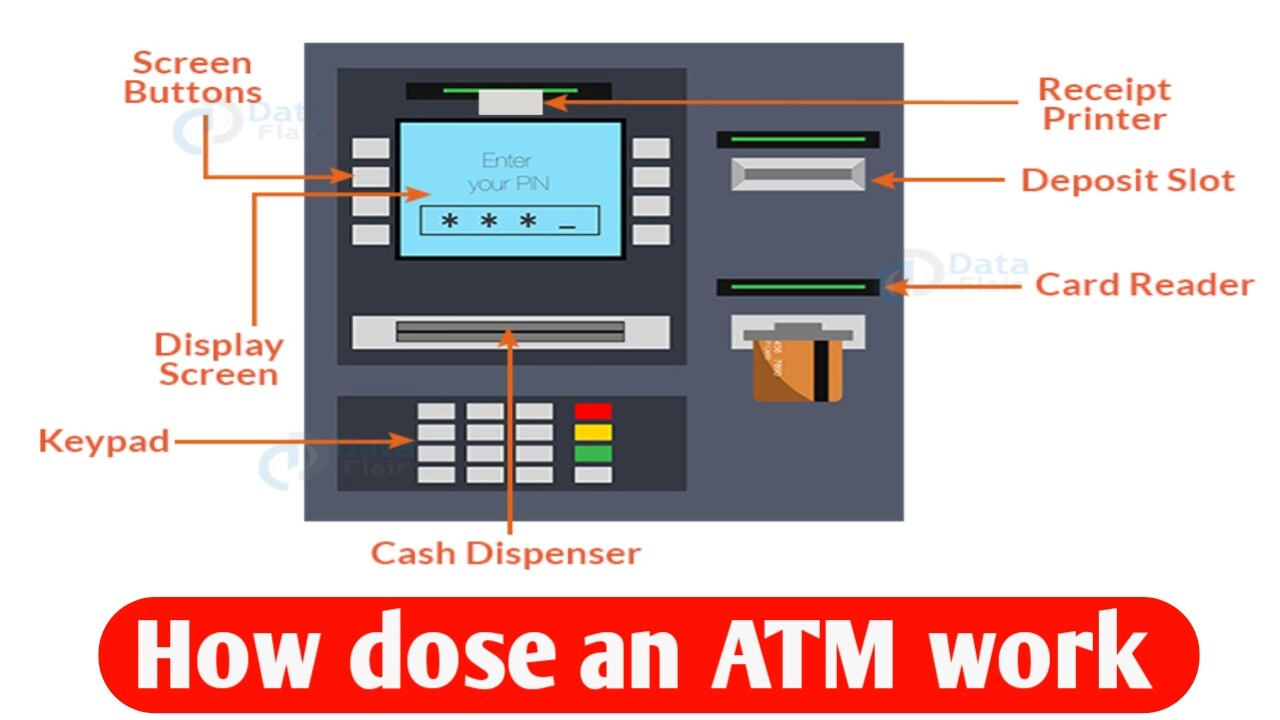
Imagine walking into an ATM booth and inserting your card; the moment you do, a process begins inside the machine. The card reader activates, establishes communication with the chip, and reads the card’s data. The ATM identifies the issuing bank and the connected network—whether it is Visa, MasterCard, RuPay, or the bank’s internal network. However, the ATM does not yet know if there are sufficient funds in the account; another step is required for that.
How does PIN verification work
The ATM then asks for your PIN. This is not merely a sequence of four or six digits; it is the password to your digital identity. Interestingly, when you enter your PIN, the ATM does not store it as plain text. Inside the ATM, there is a special PIN encryption module. As soon as you enter the PIN, it is instantly converted into an encrypted code. This means that even if someone were to intercept the data in transit, they would not be able to decipher it. The ATM then sends this encrypted data to the bank as a transaction request, marking the beginning of the ATM’s invisible journey.
How does the ATM connect to the bank
You might see the machine standing right in front of you, but in reality, the transaction travels through various digital systems across the globe. The ATM transmits the request to the bank via a network. Along the way, it passes through switches, payment networks, and processing systems, reaching your bank’s core banking server in just a few milliseconds.
There, the system verifies:
Whether the PIN is correct
Whether the card is active
Whether there is sufficient balance in the account
Whether the daily limit has been exceeded
Whether there is any suspicious activity
If everything checks out, the bank sends an approval, and the ATM receives authorization to proceed.
How is cash dispensed from inside the ATM
This is where the actual engineering behind dispensing cash begins.
There is a sturdy safe inside the ATM. How is the cash stored within it
Each cassette holds banknotes of a specific denomination—such as ₹100, ₹500, or ₹2000. If you withdraw ₹5000, the ATM calculates how many notes need to be drawn from which cassette, and then the cash dispensing system activates.
How do the sensors inside the ATM work
There are small rollers inside the ATM that pick up the banknotes one by one from the cassette. However, issues can arise here; notes might stick together, two notes might come out at once, or a note might get folded. That is why sensors are installed inside the ATM. These sensors inspect every note, checking its thickness, length, and position. If two notes come out together, the machine rejects them. If a note is damaged, it is sent to a rejection bin. In other words, the ATM doesn’t just hand out money; it also checks the quality of every note. Once the notes are successfully counted, conveyor belts arrange them into a stack.
The machine performs a final verification to see if the amount matches. If everything is correct, the cash presenter activates, and within a few seconds, the notes reach the dispensing slot.
What happens if you don’t collect the cash from the ATM
You might think the money has simply come out, but the machine is still monitoring the situation. Many ATMs can detect whether or not you have collected the cash. If you leave the cash behind, the machine can retract it to prevent anyone else from taking it.
What are the various components inside an ATM? An ATM houses a screen, keypad, card reader, printer, camera, cash dispenser, network module, UPS, and a powerful controller computer. In essence, an ATM is a mini banking robot that relies on both software and hardware.
How is security maintained in ATMs
Wherever there is money, there is a risk of fraud. Card skimming, hidden cameras, fake keypads, shoulder surfing, and card trapping are all real threats. That is why modern ATMs are equipped with advanced security systems such as anti-skimming devices, encrypted communication, real-time fraud detection, CCTV monitoring, and biometric verification. Technology is becoming smarter, and so are criminals; therefore, awareness is crucial.
The Future of ATMs
But the story of the ATM doesn’t end there; the future holds even more interesting possibilities. Today, cardless withdrawals are possible, and cash can be withdrawn using UPI. Biometric authentication and facial recognition are being implemented. Cash recycler machines are emerging—machines that can verify deposited notes and dispense them again. In the future, the ATM may evolve from a mere cash machine into a mini digital bank branch.
The Invisible World Behind the ATM
Consider how casually we use ATMs today: insert the card, enter the PIN, withdraw the cash, and walk away. Yet, behind that brief moment lies a complex blend of advanced electronics, cryptography, banking networks, mechanical engineering, thousands of software systems, and the hard work of countless people. A small ATM card acts as a bridge between you and your money, accomplishing in mere seconds a task that once required standing in long bank queues. Perhaps that is why the true beauty of technology lies not in its complexity, but in the fact that, despite being so complex, it feels simple to us. And the next time cash comes out of an ATM, remember: an entire invisible world is at work behind that single, brief moment.
Conclusion
While an ATM may appear to be a simple machine from the outside, a complex combination of electronics, cryptography, banking networks, sensors, software, and mechanical systems works behind the scenes. Within seconds of inserting your card and entering your PIN, the bank verifies the details, and the machine dispenses the correct amount of cash. Today, ATMs have made banking significantly easier and more convenient. In the future, ATMs will become even more advanced with technologies such as cardless withdrawals, UPI, biometric authentication, and cash recyclers.

I am the founder and content creator of SuperJankari.com, a technology-focused website dedicated to sharing useful information about smartphones, laptops, gadgets, apps, software, and the latest technology updates. My goal is to make technology easy to understand by providing clear, practical, and informative content for readers.