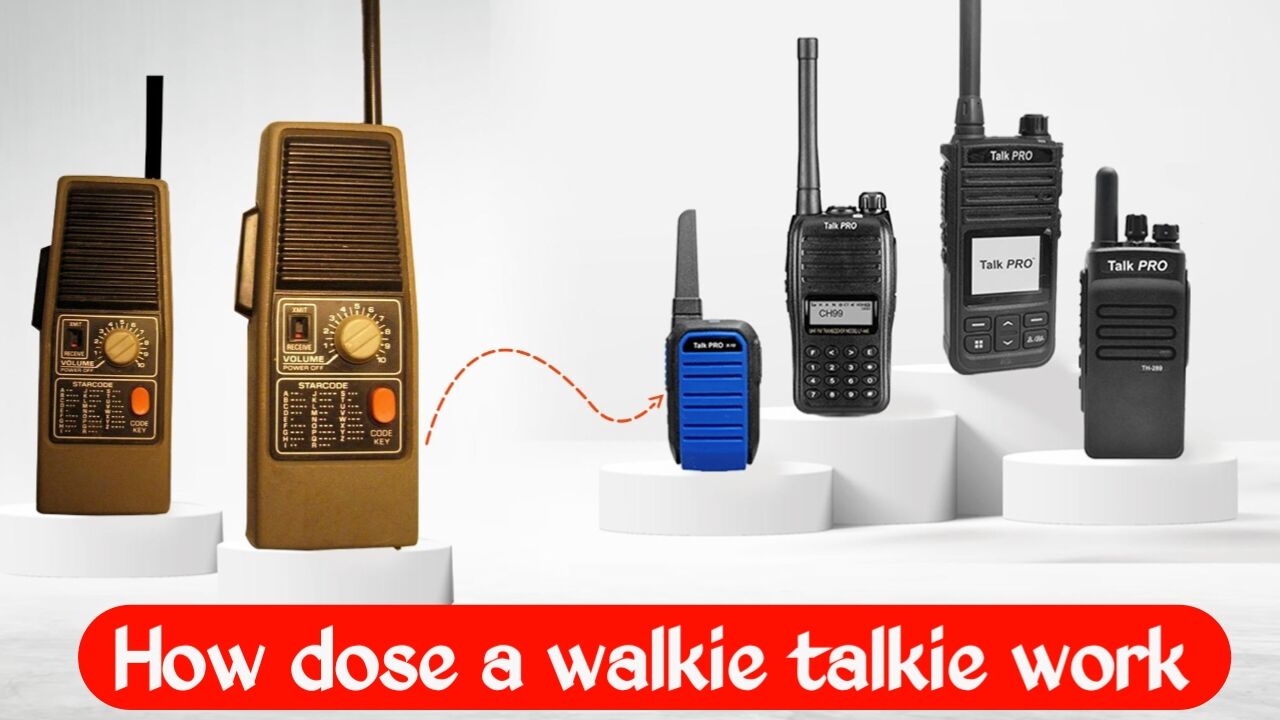
How does a walkie-talkie work? How does sound travel such a long distance via radio waves
Friends, imagine you are lost in a dense forest where there is absolutely no mobile network. Even though you have a phone, the call won’t go through. Suddenly, the walkie-talkie in your bag beeps and transmits your voice to a companion several kilometers away. No SIM card, no mobile number, and no mobile tower. So, how exactly does this small device send your voice through the air over such a distance? What happens inside the moment you press the walkie-talkie button? How are radio waves generated, and how does the other walkie-talkie reproduce that same sound? Today, we will understand the science behind this step-by-step.
The Origins of the Walkie-Talkie
Let’s go back in time a bit. The story of the portable two-way radio didn’t begin with a single inventor. Engineers were working on this concept during the 1930s and around the time of the Second World War. Donald Hings created a portable backpack radio in 1937. Alfred Gross worked on wireless communication, and teams at the Galvin Manufacturing Company collaborated to advance this technology. Walkie-talkies generally utilize a half-duplex system. When the PTT (Push-to-Talk) button is released, the radio remains in receiving mode, monitoring the channel. As soon as the PTT button is pressed, the transmitter activates, and your voice is transmitted as a radio signal. If both parties speak simultaneously, interference can occur in the communication. Therefore, the operator listens first, presses the PTT button to speak, and releases it once the message is complete, allowing the other person to reply.
What Happens When You Press the PTT Button
So, you press the PTT button and start speaking. First, the microphone captures your voice. Our voice travels through the air as pressure waves. The microphone’s diaphragm vibrates in response to these pressure changes and converts them into a fluctuating electrical audio signal. This serves as an electrical copy of your voice, though it is not yet a radio wave. Next, an amplifier boosts the signal, while filters reduce unwanted noise. The device now holds a clean electrical pattern of your voice.
How is the voice converted into a radio signal
Transmitting low-frequency audio directly over long distances via an antenna is impractical. Therefore, the electronics generate a high-frequency “carrier.” Think of the carrier as an invisible path. An oscillator and a frequency synthesizer generate a precise radio frequency corresponding to the selected channel. A channel is not a physical wire but a specific frequency position within the radio spectrum. The carrier is modulated according to the voice pattern; the receiver then recovers the audio from these variations. In digital radio, the voice can be encoded into data and transmitted using digital modulation. The underlying concept remains the same: placing information onto a radio signal and transmitting it through the air.
How are radio waves generated
Next, the power amplifier boosts the modulated RF signal so the antenna can radiate it. The signal reaches the antenna, where high-frequency alternating current rapidly changes direction. This generates fluctuating electric and magnetic fields, causing energy to propagate through space as electromagnetic radio waves. Your voice now travels not through a cable, but as information embedded in the modulation of the radio wave. This is why a mobile tower isn’t needed in direct mode; one antenna transmits the wave, and the other captures a small portion of it.
How does the second walkie-talkie reproduce the sound
Now, the process begins at the second walkie-talkie. The air contains more than just your signal; various other radio signals and noise may be present. Therefore, RF filters isolate the range around the selected frequency and reject unwanted bands. Subsequently, a low-noise amplifier boosts the weak signal. Many receivers use a mixer and a local oscillator to convert the incoming frequency into an intermediate frequency or a digital processing stage, where filtering and decoding are easier. In essence, the receiver doesn’t listen to the entire spectrum; it selects the specific frequency window corresponding to the channel your team is using.
How is the sound recovered through demodulation
Next comes demodulation. The transmitter had encoded the voice onto a carrier wave; the receiver extracts that information back out. An analog FM receiver detects the controlled frequency changes and generates an electrical audio signal. An audio amplifier then boosts this signal sufficiently to drive the speaker. The speaker’s coil and magnet vibrate back and forth, creating pressure waves in the air that we perceive as sound. So, the entire process works something like this:
Voice → Microphone → Electrical signal → Modulation → Radio wave → Antenna → Receiver → Demodulation → Speaker → Voice
How do the intended recipients hear the message when there are multiple walkie-talkies nearby
Walkie-talkies within a group are usually set to the same authorized channel or programmed frequency. However, a channel isn’t a private room; any compatible radio tuned to that same frequency can pick up the transmission. Many radios use CTCSS tones or DCS codes. The transmitter sends a specific tone or code along with the voice, and the receiver activates the speaker only upon detecting the expected code. The signal travels through the air, but the code determines whether the receiver routes the audio to the speaker or keeps it muted.
What does Squelch do
If the receiver remained constantly active, the speaker would emit hissing and static noise whenever there was no useful signal. The squelch circuit monitors signal strength or quality and opens the audio path only when a valid signal is detected. As soon as the transmission ends, the speaker mutes again. This ensures the walkie-talkie remains silent during idle periods and only produces sound when a message arrives. Professional radios may also include features like channel scanning, emergency buttons, selective calling, or encryption. Yet, the fundamental system remains the same: monitor the correct frequency, identify a valid signal, decode it, and output the audio to the speaker.
What is the range of a walkie-talkie
Now, let’s consider the range. The 5 or 10-kilometer figure printed on the box isn’t guaranteed in every situation. Range depends on factors such as transmitter power, frequency, antenna efficiency, antenna height, receiver sensitivity, terrain, and line-of-sight. In open fields or on hilltops, a clear line-of-sight allows the signal to travel much farther. Meanwhile, concrete buildings, basements, tunnels, mountains, and metal structures can absorb, reflect, or block signals. Consequently, while a radio signal can travel long distances in open areas, it may weaken quickly inside buildings. Professional networks can utilize repeaters; a repeater receives a signal and re-transmits it on a different frequency, thereby helping to extend coverage.
Key Components of a Walkie-Talkie
Several electronic and radio components work together inside a walkie-talkie.
Microphone — Converts sound into electrical signals.
Oscillator/Frequency System — Generates radio frequencies.
Modulation Circuit — Encodes audio information onto the radio signal.
Power Amplifier — Boosts the signal to be transmitted.
Antenna — Transmits and receives radio signals.
Receiver — Captures weak radio signals.
Filter — Isolates the selected frequency.
Demodulator — Extracts audio information from the radio signal.
Speaker — Converts electrical signals back into sound.
Modern radios may also feature capabilities like GPS, Bluetooth, or encryption. However, the core signal path remains the same:
Voice In → Electrical Audio → Modulation → RF → Amplification → Antenna → Transmission → Reception → Filtering → Voice Out
Where are walkie-talkies used
Walkie-talkies are used by police, fire services, disaster response teams, factories, warehouses, construction sites, airports, railways, hotels, film sets, event organizers, and security staff. Mobile calls require dialing a number, establishing a connection, and network availability. In contrast, radios allow for instant messaging to the team simply by pressing the PTT (Push-to-Talk) button; this speed is crucial during emergencies. Unnecessary chatter on a channel can block important messages. Therefore, professional communication relies on short messages, clear wording, call signs, and proper turn-taking.
Radio frequencies and regulations for walkie-talkies
The radio spectrum is a public resource; therefore, individuals cannot simply transmit on any frequency they choose. In India, wireless spectrum and radio equipment fall under the purview of the Department of Telecommunications (DOT) and relevant regulatory frameworks. Compliant equipment may operate within specific permitted or licensed bands subject to certain conditions, whereas short-range radios and professional systems may require authorization, frequency assignment, or equipment approval. Consequently, one should not assume that every walkie-talkie sold online is automatically license-free. It is essential to check the device’s frequency, transmit power, approval status, and intended use, and to verify applicable regulations before use.
How do digital walkie-talkies work
In digital radios, voice signals can be encoded as data. This enables features such as clearer audio, device identification, error correction, and encryption. However, “digital” does not imply unlimited range. If the signal is very weak, the audio may suddenly cut out or disappear.
How quickly does the battery drain
The battery consumes more power in transmit mode; therefore, continuous talking reduces runtime. Battery life can be conserved by keeping transmissions short and practicing good communication discipline.
Conclusion
So, friends, the next time you see a walkie-talkie in the hands of a security guard, police officer, or event team member, don’t just view it as a simple little box. The moment the PTT button is pressed, the microphone converts sound into an electrical signal. An oscillator generates a radio frequency. Through modulation, information is superimposed onto the carrier wave. A power amplifier boosts the signal, and the antenna converts it into electromagnetic waves to transmit through the air. The receiving antenna captures these waves. The receiver filters for the selected frequency. A demodulator extracts the audio, and the speaker reproduces your voice. This process functions in “direct mode”—without the need for SIM cards, phone numbers, or cellular towers. Ultimately, the true power of a walkie-talkie lies in the engineering hidden behind its simplicity: a combination of microphones, radio frequency electronics, modulation, antennas, electromagnetic waves, filtering, and amplification that transforms sound into an invisible signal and transmits it to another location.

I am the founder and content creator of SuperJankari.com, a technology-focused website dedicated to sharing useful information about smartphones, laptops, gadgets, apps, software, and the latest technology updates. My goal is to make technology easy to understand by providing clear, practical, and informative content for readers.