How does a camera work? A complete guide from the lens to the digital image
Cameras have become an integral part of our lives today. You pull out your smartphone, open the camera app, tap once, and the photo is ready—whether it’s a selfie, a Reel, or a family moment. But have you ever wondered how a camera actually “sees”?
How does it transform light into an image and convert a scene into a clear photograph or video?
Is a camera merely a lens, or is there a complex scientific system of optics, mirrors, sensors, shutters, processors, and software working inside? And what is the difference between DSLR and mirrorless cameras?
Today, we will explore this world of cameras, where light passes through the lens to hit the sensor, and the processor converts it into a digital image.
How did cameras originate
The camera didn’t just begin with modern technology; it started with the human desire to capture the world forever. Long ago, the concept of the *Camera Obscura* emerged, where an inverted image of the outside world would appear inside a dark room or box through a small hole. Later, lenses and light-sensitive chemicals were introduced, leading to the advent of film photography in the 19th century. The 20th century saw the arrival of compact cameras, SLRs, and DSLRs. As sensor technology advanced, cameras moved away from film and into the realm of digital processing.
How the camera captures light
First, it is essential to understand light, because a camera does not create an image on its own; it captures light reflected from objects. When light falls on a face, a tree, or any object, a portion of it travels toward the camera. This reflected light carries information about shape, color, and brightness. Our eyes operate on the same principle; the only difference is that the eye has a retina, whereas a camera has a sensor or film positioned behind the lens.
How does a camera lens work
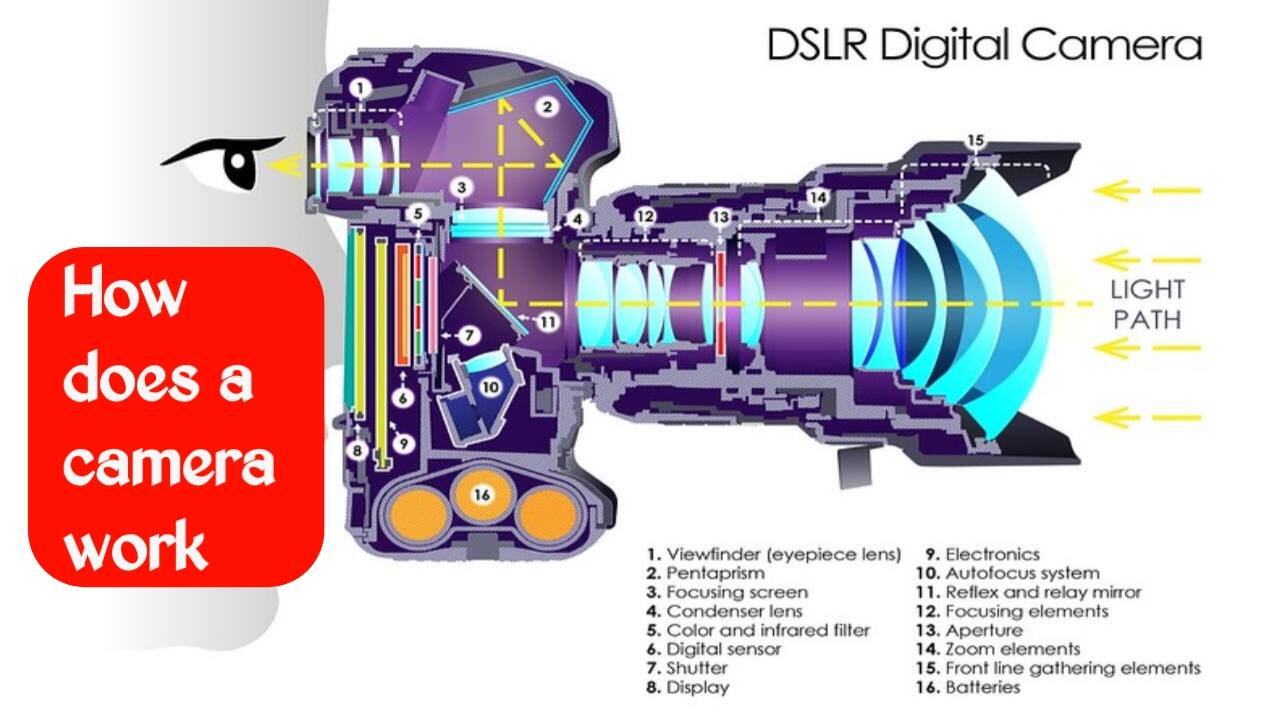
Imagine pointing your camera at a scene. Light enters the lens. A lens is not merely a simple piece of glass; rather, it is a combination of several curved glass elements. These elements bend light rays to focus them precisely onto the sensor. Without a lens, light would scatter, resulting in a blurred image. Thus, the lens’s function is to control light and project a clear image onto the sensor.
For this reason, lens quality plays a significant role in the camera’s overall image quality.
What is Aperture
A crucial component inside the lens is the aperture. The aperture is an adjustable opening that determines how much light enters the camera. A larger aperture allows more light to enter and can produce more background blur. A smaller aperture lets in less light but can keep a larger portion of the scene in focus. This mechanism controls the “depth of field”—determining whether only the subject appears sharp or the entire landscape remains in focus. That is why a large aperture is typically used for portraits, while a small aperture is preferred for landscapes.
How does a camera’s focus system work
Focusing involves rendering the subject’s image sharply on the sensor. If the subject is close, the camera adjusts the lens to achieve focus; this capability allows the camera to track objects.
How does a DSLR camera work
DSLR stands for Digital Single-Lens Reflex. In this system, light entering through the lens first strikes a mirror, which directs the light into the optical viewfinder. Consequently, when you look through a DSLR’s viewfinder, you see the actual optical light coming through the lens rather than a digital screen. As soon as the shutter button is pressed, the mirror flips up and the shutter opens. Light then hits the sensor, capturing the photo. This movement produces a mechanical sound.
How does a mirrorless camera work
Mirrorless cameras eliminate the mirror system entirely. Light entering through the lens falls directly onto the sensor. The camera captures a live image from the sensor and displays it on an electronic viewfinder or a screen. In other words, mirrorless cameras use a digital preview instead of an optical viewfinder. This allows for a smaller, lighter camera body and a simpler mechanical system. The sensor, processor, and autofocus remain active, making the camera powerful in areas like real-time exposure preview, tracking, and video capabilities.
What is a shutter
The shutter acts like a gate for the camera, determining how long the sensor receives light. If the shutter opens and closes very quickly—say, in 1/1000th of a second—fast movement can be frozen. If the shutter is slow—such as 1 second—more light enters, and moving objects may appear blurred. Long-exposure night photography relies on this principle: the shutter stays open for an extended period, allowing the sensor to convert light from a dark scene into electrical signals. A stronger signal is generated with more light, while a weaker signal results from less light; this process determines the image’s brightness.
How does the sensor record images and colors
The sensor does not perceive color directly; instead, it is covered by a Color Filter Array that collects information regarding Red, Green, and Blue.
This raises the question: if the sensor only generates signals, how is a colorful image created
This is where the camera’s image processor comes into play. The processor reads the data from the sensor and combines the Red, Green, and Blue information to calculate the actual colors. Subsequently, brightness is adjusted, noise is reduced, sharpness is enhanced, and the white balance is corrected. Finally, the image is saved as a JPEG or RAW file. In essence, creating a photograph involves not just the lens and sensor, but also digital processing.
What is ISO
ISO can be understood as a control for the sensor’s light sensitivity. At low ISO settings, images tend to be cleaner and more detailed, though they require more light. High ISO settings allow the camera to brighten images in low-light conditions, but this can introduce noise—visible as grainy dots. This is why smartphones use software processing to reduce noise in night shots. Professional cameras, equipped with larger sensors, can produce cleaner images in low light because larger pixels are capable of capturing more light. That is why, in many situations, sensor size can be more important than megapixels.
How does a smartphone camera work
Smartphone lenses are small, and their sensors are also smaller compared to those in DSLR or mirrorless cameras. Despite this, smartphone cameras produce high-quality photos and videos using various technologies and software processing.
What is the difference between optical zoom and digital zoom
Optical zoom and digital zoom should not be considered the same. In optical zoom, lens elements physically move to magnify the image in a genuine way, allowing image quality to remain high. In digital zoom, the camera crops and enlarges the central part of the image, which can result in a loss of detail. Smartphones use various lenses—such as wide, ultra-wide, and telephoto—to provide different fields of view.
How does the camera record video
During video recording, the camera continuously captures images. If a camera records video at 30 frames per second, it is capturing 30 images every second. When these images are played back rapidly, we perceive motion. Features like autofocus, exposure, stabilization, and audio sync work together during video recording. Optical stabilization reduces camera shake by slightly moving the lens or sensor, whereas electronic stabilization uses software, frame cropping, and adjustments to smooth out the video.
Key camera components
It is also important to understand the other components of the camera.
- Camera Body: It protects the camera.
- Lens Mount: It connects the lens to the camera body.
- Viewfinder या Screen: The framing shows.
- Shutter Button: It issues the command to capture a photo.
- Memory Card: Stores data.
- Battery: It powers the camera.
- Processor: Handles the image.
- Sensor: Converts light into electrical signals.
- Autofocus Motor: Adjusts the lens.
- Software: Manages exposure, color, focus, and file format.
In essence, a camera is a combination of optics, electronics, mechanics, and computing.
What determines the quality of a photo
Megapixels alone do not determine whether a photo turns out well or poorly. A good photo requires high-quality lenses, a good sensor, proper lighting, accurate focus, balanced exposure, and an understanding of composition. Often, a larger sensor with fewer megapixels yields better results, whereas a high-megapixel phone might struggle in low-light conditions. This is because the true essence of image quality lies in light capture, lens quality, and image processing.
How has camera technology transformed our lives
Camera technology has significantly changed our lives. In the past, film rolls were limited, photos had to be developed, and results were not immediately visible. Digital cameras and smartphones have made photography instantaneous. Today, cameras have become powerful tools across fields such as journalism, cinema, security, education, science, medicine, and social media. However, this has also brought risks like privacy violations, deepfakes, and fake images. In the future, sensors will become more sensitive. Technologies like AI focus and low-light enhancement will advance further, enabling cameras to analyze the scene and produce superior results.
Conclusion
The next time you take a photo with your smartphone or look at a DSLR or mirrorless camera, don’t view it merely as a machine with a button. Inside, the lens controls the light, the aperture regulates the amount of light, the shutter determines the timing, the sensor converts photons into electrical signals, the processor renders colors and details, and the software gives the image its final form. It is a magnificent blend of optics, physics, electronics, computing, and human creativity—transforming the world we see with our eyes into photos, videos, cinema, and knowledge. The next time you hear the click of a camera shutter, remember that a scientific journey of light lies hidden behind that fleeting moment. That is the beauty of technology: remarkable science often lies behind things that appear simple.

I am the founder and content creator of SuperJankari.com, a technology-focused website dedicated to sharing useful information about smartphones, laptops, gadgets, apps, software, and the latest technology updates. My goal is to make technology easy to understand by providing clear, practical, and informative content for readers.