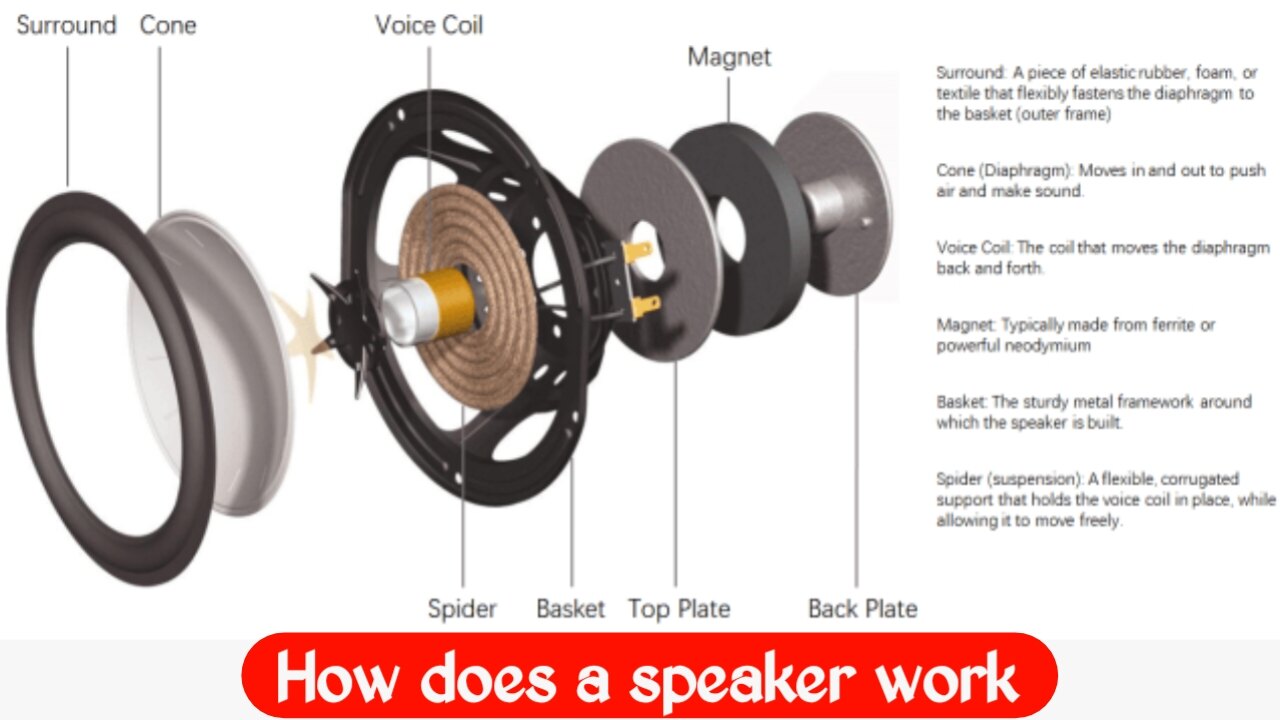
How does a speaker work? How is sound created from an electrical signal?
Friends, listening to music has become so easy these days. You simply play a song on your mobile, turn on the TV, put in your earphones, or stand in front of a DJ speaker, and within seconds, music, dialogue, a voice from a call, or a singer’s voice reaches your ears.
But have you ever wondered how a small, silent speaker actually produces sound? There is no singer sitting inside it, nor is there a fan blowing air; yet, how does it produce various sounds like bass, treble, beats, vocals, and explosions? Today, we will explore the inner workings of a speaker, where electrical signals, magnets, coils, and a diaphragm work together to move the air.
What is sound
Before understanding the speaker, we must understand sound, because a speaker doesn’t create something magical; it simply generates vibrations in the air. When an object moves rapidly back and forth, the surrounding air compresses and expands—meaning air molecules move closer together and then further apart. If this pressure changes slowly, the sound is perceived as low-pitched, and if the vibration is rapid, the sound is perceived as high-pitched. The speaker’s primary function is to convert electrical signals into mechanical vibrations.
How is sound created from a mobile’s digital data
Imagine you have a song stored on your mobile. It isn’t actual sound; rather, it is digital data—information in the form of zeros and ones. When the song plays, the phone’s processor reads the data. Then, a Digital-to-Analog Converter (DAC) transforms it into a continuous electrical signal. This signal mirrors the song’s waveform. This fluctuating signal travels to the speaker, which then creates corresponding vibrations in the air.
Key parts of a dynamic speaker
The most common type of speaker is the dynamic speaker. The same principle is used in mobile phones, TVs, home theater systems, DJ speakers, and many types of earphones.
Its main components are:
- Permanent Magnet
- Voice Coil
- Cone या Diaphragm
- Suspension
- Spider
- Frame
- Dust Cap
Permanent Magnet
The permanent magnet creates a strong magnetic field inside the speaker.
Voice Coil
The voice coil is a coil of thin copper wire attached to the cone.
Cone or Diaphragm
The cone is a lightweight surface that pushes air back and forth.
Suspension and Spider
The suspension and spider help keep the cone in the correct position.
How does the voice coil produce sound
When an electrical signal from the amplifier enters the voice coil, the coil becomes a temporary electromagnet. The direction and strength of the electricity constantly change, causing the coil’s magnetic field to change as well. The permanent magnet and the coil’s changing magnetic field then interact; the coil is alternately pushed away from and pulled toward the magnet. This push-and-pull action causes the voice coil to move back and forth. Since the coil is attached to the cone, the cone vibrates in the same pattern. As the cone moves forward, the air in front is compressed, and as it moves backward, the air expands. This compression and expansion create sound waves that reach the ear. In other words, the speaker does not produce sound directly from electricity; instead, it uses electricity to create vibrations, and those vibrations generate sound waves in the air.
How are different sounds produced
If the signal contains a singer’s voice, the cone vibrates in the pattern of that voice. If the signal contains a drum beat, the cone moves suddenly and forcefully. If the signal contains bass, the cone makes slow but long movements. If the signal contains high-frequency sound, the cone makes rapid, small movements. The more accurately the signal is followed, the clearer the sound will be.
What is the function of an amplifier
The amplifier plays a crucial role here. The signal coming from a mobile phone or music player is very weak; it cannot directly drive a large speaker loudly. Therefore, the amplifier boosts the signal’s power so that sufficient current reaches the voice coil, enabling the cone to vibrate vigorously. In DJ speakers, the amplifier is powerful, allowing for larger and more robust drivers and magnets. Conversely, the amplifier in a mobile phone is small, which limits the loudness.
How does a mobile speaker work
Space is very limited in mobile phones, so the speakers are designed to be extremely compact. They also contain magnets, coils, and diaphragms, but in miniature form.
A mobile speaker is not exposed like a large cone speaker; it is accompanied by an acoustic chamber and a small sound port. Even so, mobile speakers cannot produce deep bass because generating bass requires moving a large volume of air, and a small diaphragm lacks the necessary physical space to do so. Consequently, while mobile phones can achieve high volume, they do not deliver the thumping bass found in DJ systems.
How does a mobile speaker work
Space inside a mobile phone is very limited, so the speaker is designed to be extremely compact. It contains the same components—magnets, a coil, and a diaphragm—but in miniature form. Unlike a standard speaker, a mobile speaker isn’t open to the air via a large cone; instead, it is paired with an acoustic chamber and a small sound port. Even so, mobile speakers struggle to produce deep bass because generating bass requires moving a large volume of air, and a small diaphragm simply lacks the physical space to do so. Consequently, while mobile phones can achieve high volume, they cannot deliver the thumping bass associated with DJ systems.
How do speakers work in earphones and earbuds
In earphones or earbuds, the speaker component is known as a “driver.” These are typically tiny dynamic drivers featuring small magnets, small voice coils, and thin diaphragms. Since earphones sit right next to the ear, they do not need to move large amounts of air; even minute vibrations are sufficient to deliver clear sound to the ear. This allows earphones to produce high-quality sound while consuming very little power.
How do DJ speakers and large loudspeakers work
The world of DJ speakers and large loudspeakers is quite different. These systems often rely on multiple drivers working in unison rather than just a single speaker unit.
- Woofer It is for the base.
- Mid-range Driver It is for vocals and instruments.
- Tweeter High-frequency sound is responsible for elements like cymbals, sharp voices, and detail.
Since a single cone cannot perfectly reproduce all frequencies, a crossover circuit splits the audio signal into different frequency ranges and directs them to the appropriate drivers.
Main Types of Speakers
There are several types of speakers:
1. Dynamic Speaker:
This is the most common type, utilizing a magnet and a voice coil.
2. Electrostatic Speaker:
In this type, a very thin, charged diaphragm vibrates in response to an electric field.
3. Planar Magnetic Speaker:
This features a flat diaphragm with conductive traces that are moved by magnets.
4. Piezoelectric Speaker:
Here, a crystalline material expands or contracts when voltage is applied, generating sound. Additionally, there are horn speakers, which use a horn-shaped structure to direct and amplify sound.
How is a Speaker Made
Let’s understand the speaker manufacturing process simply. First, the sizes of the magnet, voice coil, cone, suspension, and frame are determined. The cone can be made from paper, plastic, metal, fiber, or composite materials. The voice coil is wound using copper or aluminum wire, and the magnet can be made of ferrite or neodymium. Next, the coil is attached to the cone and centered within the frame. Finally, terminals are installed, and the entire assembly undergoes testing.
Why is a Speaker Cabinet Important
The speaker cabinet is just as important as the speaker driver itself. If a driver is operated without an enclosure, the sound waves emanating from the front and back can cancel each other out, particularly in the bass range. That is why speakers are mounted in wooden, plastic, or metal enclosures. A sealed box delivers accurate bass; a bass reflex port boosts low frequencies; and a horn-loaded cabinet helps project sound over longer distances. DJ speaker cabinets are built to be robust so that they do not suffer damage or produce unwanted rattling due to intense vibrations.
What is distortion
When a speaker fails to accurately reproduce the signal, the sound quality suffers. If the amplifier delivers excessive power, the voice coil can overheat. The cone may move beyond its limits, causing the sound to become distorted or “break up.” This phenomenon is known as clipping or distortion.
For this reason, every speaker has certain key specifications:
- Watt Rating – Indicates power handling.
- Impedance – Important for amplifier matching.
- Frequency Response – Indicates the speaker’s sound range.
Why does the bass from a speaker feel so powerful
Bass consists of low-frequency vibrations that require the speaker cone to push a significant amount of air. Larger woofers have a greater cone surface area, allowing them to move more air. Subwoofers are specifically designed for deep bass; they often feature powerful magnets, long voice coils, flexible suspension systems, and large cabinets.
When a subwoofer receives a low-frequency signal, the cone moves over a greater distance to generate a strong pressure wave—one that the body perceives as physical vibration.
The relationship between microphones and speakers
A microphone converts sound waves into electrical signals, whereas a speaker converts electrical signals back into sound waves. When a singer performs into a microphone, the device transforms their voice into a signal. A mixer processes this signal, an amplifier boosts its power, and the speaker converts it back into sound waves in the air, delivering the audio to the audience.
Conclusion
So, the next time you hear a mobile ringtone, music through earphones, dialogue from a TV, or bass thumping from a DJ speaker, don’t just view it as a simple box that produces sound. Inside, a magnet is generating an invisible field, a voice coil is pushing and pulling in response to electrical signals, the cone is compressing and expanding the air, an amplifier is supplying energy, and the cabinet is shaping the sound. In essence, a speaker is more than just a device; it is a magnificent blend of electricity, magnetism, mechanics, materials science, and human hearing. A tiny coil, a magnet, and a diaphragm work together to bring us music, movies, calls, announcements, and the sounds of the entire world.

I am the founder and content creator of SuperJankari.com, a technology-focused website dedicated to sharing useful information about smartphones, laptops, gadgets, apps, software, and the latest technology updates. My goal is to make technology easy to understand by providing clear, practical, and informative content for readers.