How do LED and LCD TVs work? What is inside the TV
Friends, from the outside, a slim TV mounted on a wall looks like nothing more than a screen and a frame. Yet, the moment you press a button on the remote, faces, colors, and a moving world appear on that very same black screen. What components are actually hidden inside the television?
Which part handles the power? Which one interprets the video signal, and which one commands the millions of pixels? How does white light transform into a green field, a blue sky, and colorful clothing? Why does the picture appear to move when not a single pixel on the screen actually shifts from its position? And what is the real difference between LCD and LED TVs? To answer these questions, we will first look at the TV’s construction and its internal components. Then, we will understand the process of how a complete picture is formed from a signal.
TV Construction and Key Components
The outermost part of the TV is a plastic or metal frame known as the bezel. It supports the delicate display panel along its edges. There is a protective layer at the front, with the actual LCD panel situated behind it. Although the panel appears thin, it consists of multiple microscopic layers bonded together. A metal chassis at the rear provides structural strength and holds the electronic boards in place. The back cover offers protection against dust, accidental contact, and the internal electrical components. Ventilation openings help dissipate heat generated by the circuits. At the bottom, an infrared receiver captures commands from the remote, while a status light indicates the TV’s operational state.
The main components located inside the back cover are:
Power Supply Board
Main Board
T-Con Board
Backlight System
Display Panel
The power board converts the household AC electricity into regulated DC voltage suitable for the circuits. The main board acts as the TV’s brain, housing the processor, memory, tuner, storage, and input connections.
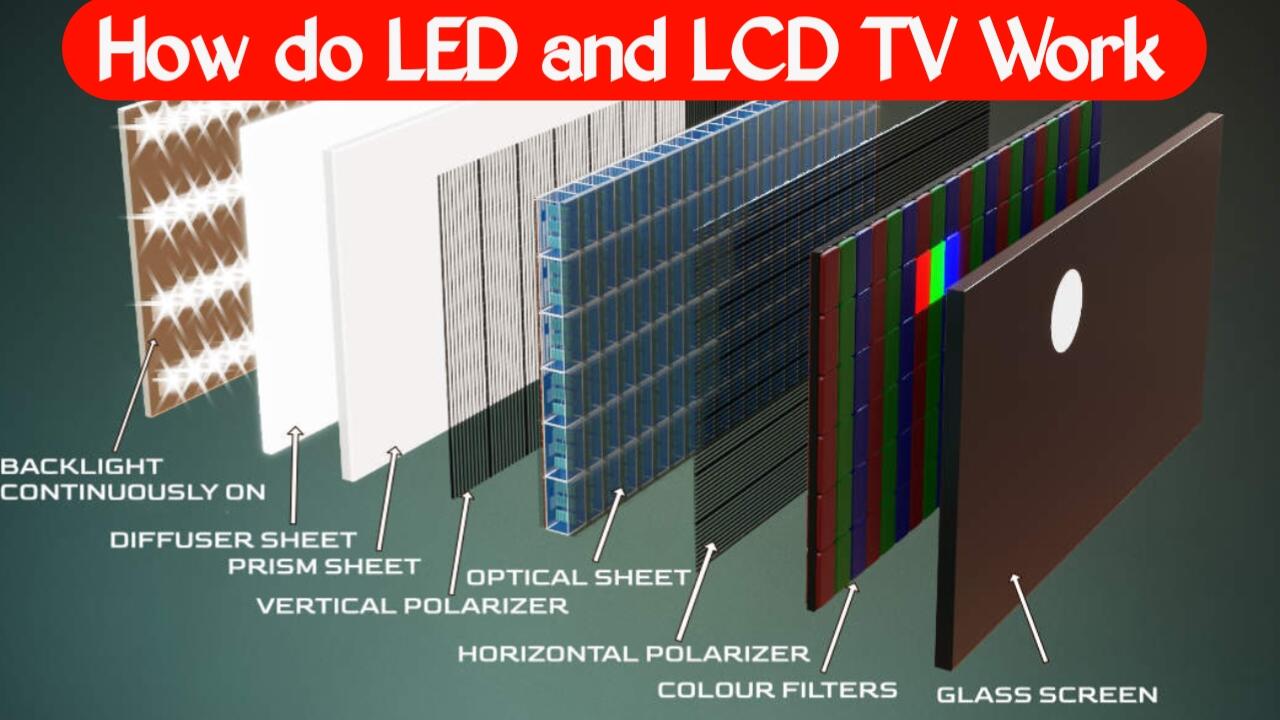
The T-Con (Timing Controller) delivers the processed video frames to the panel’s pixels at the precise moment required. Behind the screen, LED strips, reflectors, light guides, and diffuser sheets combine to form the backlight system. At the very front, the LCD panel contains polarizers, liquid crystals, color filters, and microscopic Thin-Film Transistors (TFTs). If any critical component among these malfunctions, the TV may turn on but fail to produce a proper picture, color, backlight, sound, or timing.
How does the power supply board work
The power supply board is the first to operate. AC power from the socket is not fed directly to the processor or panel because these circuits require stable, specific low-DC voltages. The power board rectifies and filters the electricity to generate the necessary voltage rails. Upon pressing the power button, the main board sends a signal to activate the other circuits. Power is then supplied sequentially to the processor, memory, panel drivers, and backlight driver. The backlight driver delivers controlled current to the LEDs, ensuring their brightness remains within safe limits. Thus, the power board forms the foundation for the television’s safe startup and stable operation.
How does the video signal reach the TV
Once powered up, the main board identifies the picture source. This source could be an antenna, set-top box, dish receiver, HDMI, cable, USB drive, or a streaming app. If the signal comes from an antenna, the tuner isolates the frequency of the selected channel. This data is not the actual image itself but encoded information regarding color, brightness, movement, and timing. The video is then generated; scaling adjusts the resolution to match the screen, while picture processing enhances color and contrast and reduces unwanted noise. The prepared frame is temporarily stored in the memory’s frame buffer. The main board’s significance lies in its ability to convert various sources and formats into an organized picture stream that the panel can interpret.
How does the T-Con board control the pixels
The picture stream travels from the main board to the T-Con board. A single frame is composed of the color and brightness values of millions of pixels; therefore, it is essential to send commands to all pixels in the correct sequence. The T-Con converts the frame data into specific row and column instructions. The Gate Driver determines which horizontal row is active at any given moment, while the Source Driver supplies the necessary voltage to each sub-pixel within that row. This scanning process occurs so rapidly from top to bottom that the individual formation of rows is imperceptible to the eye. Thus, the T-Con acts as a translator between the processor and the physical pixels. While the main board dictates the frame’s appearance, the T-Con determines exactly when and how much electrical command is delivered to specific microscopic sections of the panel.
How is light generated in an LCD screen
To display an image, light is required. LCD stands for Liquid Crystal Display, and since liquid crystals do not generate light themselves, a backlight is installed behind the panel. In modern LED TVs, white LEDs produce this light. If LEDs are positioned only along the edges, a light guide plate distributes that edge light across the entire surface. Diffuser sheets blend bright spots to ensure uniform illumination, while prism films direct more light toward the viewer. This creates a uniform white field behind the LCD layer. The backlight provides the necessary illumination, but at this stage, it is merely white light—not a complete image. The LCD panel is responsible for controlling this white light.
How do liquid crystals control brightness
A polarizing filter is positioned in front of the backlight. While ordinary light vibrates in multiple directions, a polarizer allows light of only one orientation to pass through. Liquid crystal molecules can alter their alignment when subjected to voltage. A transistor connected to each sub-pixel applies a steady electrical charge to that area. As the charge changes, the molecules rotate the polarized light by varying degrees. The second polarizer placed at the front allows only light with the appropriate orientation to pass through. More light is allowed through for bright sub-pixels, while it is largely blocked for dark ones; for intermediate brightness levels, a portion of the light passes. Liquid crystals do not create color themselves; their role is to control the amount of light emitted by each sub-pixel.
What do TFTs and Active Matrix do
A Thin-Film Transistor (TFT) and a small capacitor are connected to each sub-pixel. This arrangement of millions of sub-pixels is known as an Active Matrix. The Gate Driver selects a specific row, and the Source Driver supplies a calculated voltage to the sub-pixels in that row via the columns. The TFT acts as an electronic switch, delivering the charge to the correct location, while the capacitor holds that charge until the next refresh cycle, ensuring the brightness remains stable. Then, the next row is selected, and the process repeats across the entire panel. Since a standard pixel consists of three sub-pixels, the number of control points triples. As these states change constantly, TFTs are essential for independently controlling each sub-pixel.
How is a color image created from white light
Color filters transform the white light into a color image. Each pixel is typically divided into three sub-pixels containing Red, Green, and Blue filters. Light controlled by the liquid crystals passes through these filters. The processor independently determines the brightness of each of the three sub-pixels. If Red and Green shine with the appropriate intensity, the color Yellow appears. Green and Blue combine to create Cyan, while Red and Blue create Magenta. If all three shine at full intensity, the eye perceives White; if all three are off, the pixel appears Black. Combinations of varying intensities produce millions of colors and shades. The sub-pixels are so small and closely packed that, from a normal viewing distance, our eyes do not distinguish them individually but instead perceive their combined light as a single color. Thus, each pixel acts as a tiny color sample of the entire scene, and the millions of pixels on the screen combine to form faces, objects, backgrounds, and the complete frame.
How does moving video appear on a TV
To create moving video, the TV continuously displays new frames. In one frame, a ball might be near a player; in the next, it appears slightly further ahead, and in subsequent frames, it appears moving in a different direction. When frames change rapidly, our visual system perceives them as continuous movement rather than a series of distinct images. The “refresh rate” indicates how many times per second the panel can update the image. With every refresh, the T-Con (Timing Controller) sends new values; the TFT charges change, and the liquid crystals adjust to the new brightness levels. If the liquid crystals’ response is slow, a blur may appear behind fast-moving objects. The processor can attempt to smooth out the motion using techniques like Motion Estimation or Frame Interpolation. All these processes are repeated continuously every second.
How does the TV screen create a moving world
As a result, millions of microscopic light gates—stationary in their positions—create a moving world before our eyes. The slim television screen is a sophisticated blend of electronics, optics, materials science, and human vision. The panel, which appears simple from the outside, is internally transforming incoming signals into light, light into color, and rapidly changing colors into a lifelike moving picture.
Conclusion
Overall, various electronic and optical components work together behind the TV’s slim screen. The power supply converts electricity into the required voltage, the main board processes video signals, the T-Con board controls the timing of the pixels, and the backlight illuminates the screen. Subsequently, the LCD panel modulates the brightness of millions of sub-pixels to transform white light into various colors. Rapidly changing frames create the illusion of a moving image on the screen. In this way, the different components inside the TV collaborate to transform digital signals into a complete, colorful picture for the viewer.

I am the founder and content creator of SuperJankari.com, a technology-focused website dedicated to sharing useful information about smartphones, laptops, gadgets, apps, software, and the latest technology updates. My goal is to make technology easy to understand by providing clear, practical, and informative content for readers.