How do solar panels work? How is electricity generated from sunlight
Just imagine if I told you that a power plant operates right above your head every day—one that never shuts down, requires no petrol or diesel, and emits no smoke. Yet, it delivers so much energy that its power is almost impossible to fathom when compared to the needs of all human civilization.
You might find that hard to believe. We are talking about the Sun. The very Sun whose heat drives you indoors at noon—prompting you to switch on fans, coolers, or air conditioners—is the same source whose light can be converted into electricity by a simple black panel installed on your roof. But the real marvel lies in the fact that there are no spinning engines, no rotating turbines, and no burning fuel inside that panel; electricity is generated nonetheless.
So, the question arises: how exactly does light turn into electricity
Rays from the Sun travel millions of kilometers to reach Earth. What happens inside a solar panel that allows tiny particles of light to energize electrons—electrons that eventually become the electricity powering your home’s fans, TVs, refrigerators, and even air conditioners? And here’s an intriguing point: if the Sun isn’t visible at night, how does the electricity generated during the day reach your home after dark? Today, we won’t just look at solar panels from the outside; we will delve into the invisible world within, where photons, electrons, silicon, and electric fields interact in a process that results in the electricity powering your home.
How did solar panels originate
To understand this story, we need to step back in time. The year was 1839 when a young French scientist, Edmond Becquerel, observed a phenomenon that would eventually lay the foundation for the entire solar industry. He discovered that exposing certain materials to light could generate an electric current. At the time, perhaps no one imagined that this small scientific discovery would one day generate electricity on rooftops across the globe. This phenomenon was later termed the “photovoltaic effect.” However, scientists then lacked the technology to harness it on a large scale. Over the 19th and 20th centuries, understanding of semiconductors and electronics advanced. Finally, in 1954, scientists at Bell Labs in the US developed a practical silicon solar cell with an efficiency of around 6%. While this figure might seem low today, it was a monumental achievement at the time. Initially, solar cells were extremely expensive. Consequently, they were used in satellites sent into space—where sunlight was abundant but transporting conventional fuel was difficult—rather than in ordinary homes. Gradually, technology improved, production increased, and costs dropped; the very technology once confined to space has now reached the rooftops of our homes.
What is inside a solar panel
From the outside, a solar panel looks like a simple black plate. However, several components work together inside it. The top layer consists of strong, transparent glass that protects the solar cells from rain, dust, wind, and external impact while allowing sunlight to pass through. Beneath this lies a material that provides structural strength to the cells and helps shield them from moisture. Next comes the component where the actual electricity generation takes place: the silicon solar cell.
What does a silicon solar cell do
Silicon is a semiconductor. This means it neither conducts electricity as easily as a metal nor blocks it completely like an insulator. By manipulating its electronic structure, conditions are created that make it possible to convert light energy into electrical energy. Various layers are formed within the solar cell, creating a junction between them. An electric field develops around this junction, which subsequently helps guide liberated electrons in a specific direction. How does a photon transfer energy to an electron?
Now comes the most exciting part of the entire system. Sunlight is not merely brightness; it carries energy. This energy can be visualized as tiny packets known as photons. When a photon with sufficient energy reaches the silicon, it transfers that energy to an electron, knocking it out of its bound state. An electron is now free, but its liberation alone does not generate electricity. If the electron simply wandered aimlessly, its energy would not be put to any useful work. This is where the electric field inside the solar cell comes into play; it helps direct the charges in specific directions. When the solar cell is connected to an external circuit, the electrons flow through that circuit, and this controlled flow becomes electric current. In other words, no engine pistons moved, and no turbine spun to generate electricity. Instead, sunlight energized the electrons within the silicon, and we harnessed the movement of those electrons as electricity.
How does an entire solar panel generate so much electricity
This raises another question: if a single solar cell generates so little electricity, how does a full panel installed on the roof power so many appliances? The answer lies in thousands of tiny connections and the right design. Multiple solar cells are interconnected to form a large module, and several modules combine to create a solar panel or a larger solar system. Depending on the household’s needs, multiple panels can be connected in series or parallel configurations. Similarly, in large solar power plants, thousands of panels work in unison; each panel generates DC electricity from sunlight, and the entire system channels that power for use.
How is the solar panel’s DC electricity converted into AC
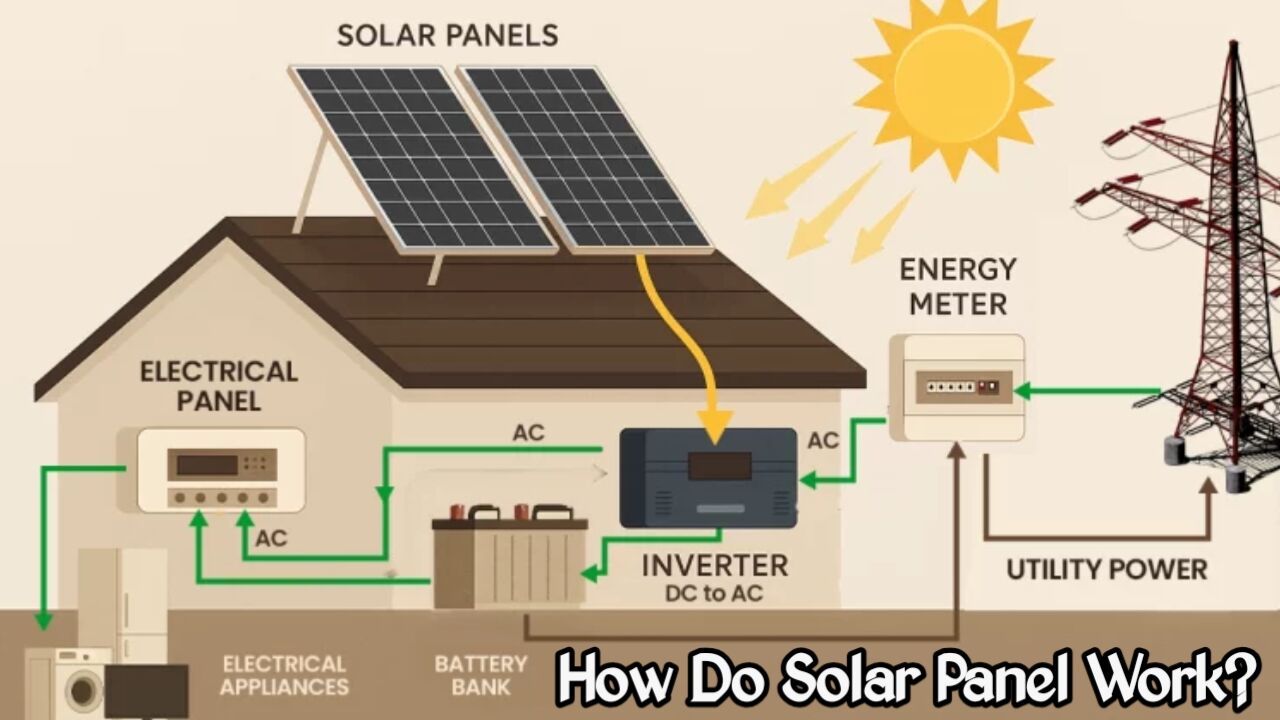
There is a crucial point here: the electricity produced by solar panels is DC (Direct Current), whereas most household appliances run on AC (Alternating Current). This is why the inverter plays a vital role in a solar system. The inverter converts the DC electricity from the panels into AC so that household appliances can use it. Modern inverters do more than just convert the form of electricity; they monitor the system, ensure safety, and help utilize available solar energy more efficiently. In short, while the solar panel generates the electricity, the inverter is equally essential in making that power suitable for household use.
Where does the electricity come from at night
Now for the biggest question: the sun has set, and the panels are no longer receiving sunlight—so where does the home’s electricity come from at night? If the solar system includes a battery, the excess electricity generated during the day can be stored in it. This stored energy can then be used to power household appliances at night. Alternatively, in a grid-connected system, excess electricity generated during the day can be fed into the grid, and power can be drawn from the grid when needed. The specific method depends on the system setup and local regulations. In other words, a solar panel is not merely a machine for generating electricity; when combined with batteries, an inverter, and the grid, it forms a complete energy system.
Do solar panels work during cloudy or rainy weather
So, if it gets cloudy or starts raining, do solar panels stop working completely? Not necessarily. Cloud cover reduces the amount of light reaching the panels, which can lead to a drop in electricity generation. However, as long as there is some light available, the panels can still produce electricity. This is why solar panels are not limited to regions with hot, clear weather. Interestingly, solar panels require light rather than heat to generate electricity. Consequently, they can function effectively in cold weather; in fact, lower temperatures can sometimes even enhance electronic performance.
Why is solar energy so significant
Here is a point that might really make you think: the amount of energy reaching Earth from the sun is immense—far exceeding the total energy requirements of human civilization. The problem, therefore, is not a lack of energy sources. The real challenge lies in how efficiently we can capture that energy, convert it into electricity, store it, and transport it to where it is needed. Solar panels offer a major solution to this challenge. As technology advances, solar cells are becoming more efficient, production costs are dropping, and the adoption of solar energy is growing across the globe.
The journey of electricity: From sunlight to your home
The next time you find yourself bothered by the scorching afternoon sun and complaining about the heat, take a moment to remember that this very sunlight falling on your roof has the potential to generate electricity. Light from the sun travels to Earth. Photons strike the solar cells. Electrons within the silicon gain energy. An electric field organizes their movement. Electrons flow through an external circuit, generating DC electricity. An inverter then converts this into AC electricity. And ultimately, that very energy powers the lights, fans, TV, and other appliances in your home. So, friends, here’s a question: if you could get solar panels installed on your roof for free, would you go for it? Do let us know in the comments. Friends, here’s another question for you: if your electricity bill were eliminated forever, would you want to install solar panels, and why? Tell us in the comments.
And the final question—do you have solar panels installed at your home or not?
Conclusion
Solar panels are a technology that converts sunlight directly into electricity. Silicon solar cells, photons, electrons, and electric fields work together within them to generate power. An inverter converts the DC electricity produced by solar panels into AC electricity, which can be used to operate household appliances. With the help of batteries and the grid, this electricity can also be utilized at night or whenever needed. Sunlight is a vast source of energy for us, and solar panels provide a crucial method for converting that energy into usable electricity.

I am the founder and content creator of SuperJankari.com, a technology-focused website dedicated to sharing useful information about smartphones, laptops, gadgets, apps, software, and the latest technology updates. My goal is to make technology easy to understand by providing clear, practical, and informative content for readers.