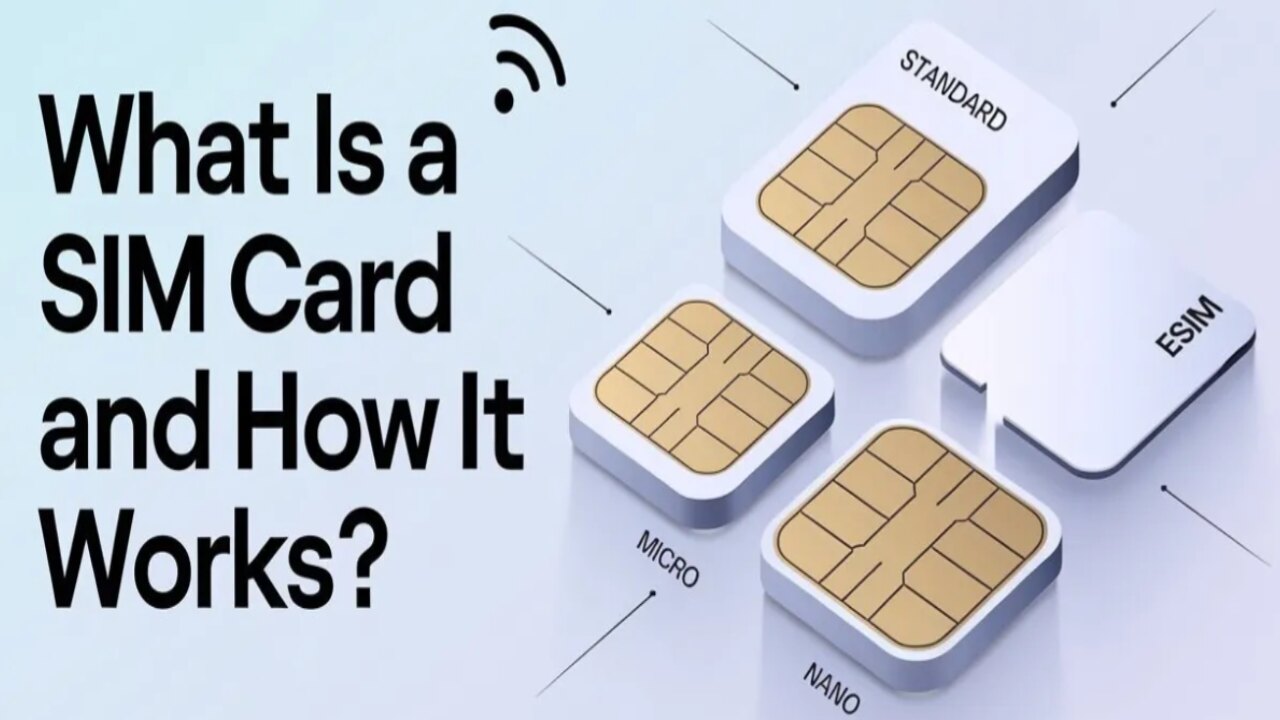
What is a SIM card and how does it work? Find out what’s inside it.
Friends, reach into your pocket right now and take out your phone. There is a tiny object inside your phone; it may look small, but without it, making calls, sending messages, and using the internet would be impossible.
We are talking about the SIM card.
Have you ever wondered what is actually inside this small plastic SIM? How does the network know that the SIM belongs to you? How does your number start working when you insert it into a different phone? And perhaps the most interesting question: if there is just a tiny chip inside, why are SIM cards cut down to smaller sizes? Let’s find out more about SIM cards.
When did SIM cards originate
The story of the SIM card begins around 1991. At that time, mobile phones were not available to the general public, and mobile technology was not as advanced as it is today.
In early mobile systems, user identification was tied directly to the phone itself; in other words, the phone and the number were linked. Changing your phone could often mean changing your number as well. Then came SIM technology, which decoupled user identity from the specific handset. Now, a SIM could be removed from one phone and inserted into another, allowing you to use your number on a different device. This marked a major shift in the world of mobile technology.
How is a SIM card made
A SIM card starts with a silicon wafer. Silicon is the same material used to manufacture computer processors and other microchips. First, a microchip is created on the silicon wafer. This process involves fabricating incredibly small electronic circuits. The work is carried out in a “clean room”—an environment kept so pristine that airborne dust particles are minimized, as even a tiny speck of dust could damage the microchip. Once the microchip is ready, it is cut to size and mounted onto a plastic card.
What is inside a SIM card
Inside the SIM card, there is a tiny microchip. This chip securely stores essential information regarding your mobile identity and network details. It contains various components related to data and security, including information about your mobile identity and other network-related data. You will notice small gold-colored sections on the SIM card; these are known as “contact points.” When you insert the SIM into your phone, the pins inside the device make contact with these points, establishing a connection between the phone and the SIM.
What is the most significant feature of a SIM card
The most remarkable aspect of a SIM card is not merely its hardware, but its security capabilities. When your SIM connects to a mobile network, the network verifies whether the SIM actually belongs to the authorized user. The SIM contains critical security data, such as a “secret key.” This data works in conjunction with the network’s own security information to authenticate the SIM’s identity. When you use the network, an authentication process takes place between the network and the SIM. If the responses from both sides match correctly, the SIM is authenticated. The purpose of this process is to ensure that the SIM connecting to the network is genuine and authorized.
Why are SIM cards made in smaller sizes
Now, a question arises: why is the SIM card cut down to a smaller size? Initially, full-size SIMs were used. Subsequently, the use of Mini SIMs, then Micro SIMs, and finally Nano SIMs became widespread. Is something actually removed from the inside each time the SIM is made smaller? The answer is no. In reality, the SIM’s microchip is already very small. The plastic portion that gets trimmed away is primarily excess plastic. In other words, the size of the core chip itself is not reduced in the same way the outer plastic casing is when moving from a full-size SIM to a Micro or Nano SIM. Over time, the SIM’s design has shrunk, and the amount of excess plastic has been reduced.
What is an eSIM
A more modern form of the SIM card has emerged today, known as the eSIM. With an eSIM, there is no need to insert a separate plastic SIM card; the technology associated with the SIM is embedded directly within the phone. You can activate network details on your phone simply by scanning a QR code. This eliminates the need to physically insert or remove a SIM card.
How does the number work when the SIM is moved to another phone
You may have noticed that if you remove your SIM card and insert it into a different phone, your mobile number continues to work on that new device. This happens because your mobile identity is linked to the SIM and the mobile network, not the phone itself. When the SIM is placed in another phone, the new device connects to the mobile network via that SIM; the network recognizes the SIM’s identity and provides service accordingly.
How does a SIM work abroad
Another interesting aspect is that when you travel to another country, your SIM often connects to a local network there. This is known as roaming. The foreign network communicates with your SIM’s home network, and once your identity and service status are verified, you are granted access to mobile services on that network. This is what allows you to make calls and use mobile network services while abroad.
What is special about a SIM card
When you open your phone’s SIM tray and look at that tiny SIM card, it appears quite ordinary. However, it securely stores vital information regarding your mobile identity and network connection. It is this tiny chip that enables your phone to connect to the mobile network, granting you access to services such as calls, messaging, and the internet.
Conclusion
Although the SIM card is very small in size, it plays a crucial role in mobile networking. The microchip, identity, and security systems within it work together to connect your phone to the mobile network. Over time, the size of SIM cards has shrunk, and technologies like eSIM have now emerged. While this small chip may appear simple, the technology behind it is truly fascinating.

I am the founder and content creator of SuperJankari.com, a technology-focused website dedicated to sharing useful information about smartphones, laptops, gadgets, apps, software, and the latest technology updates. My goal is to make technology easy to understand by providing clear, practical, and informative content for readers.