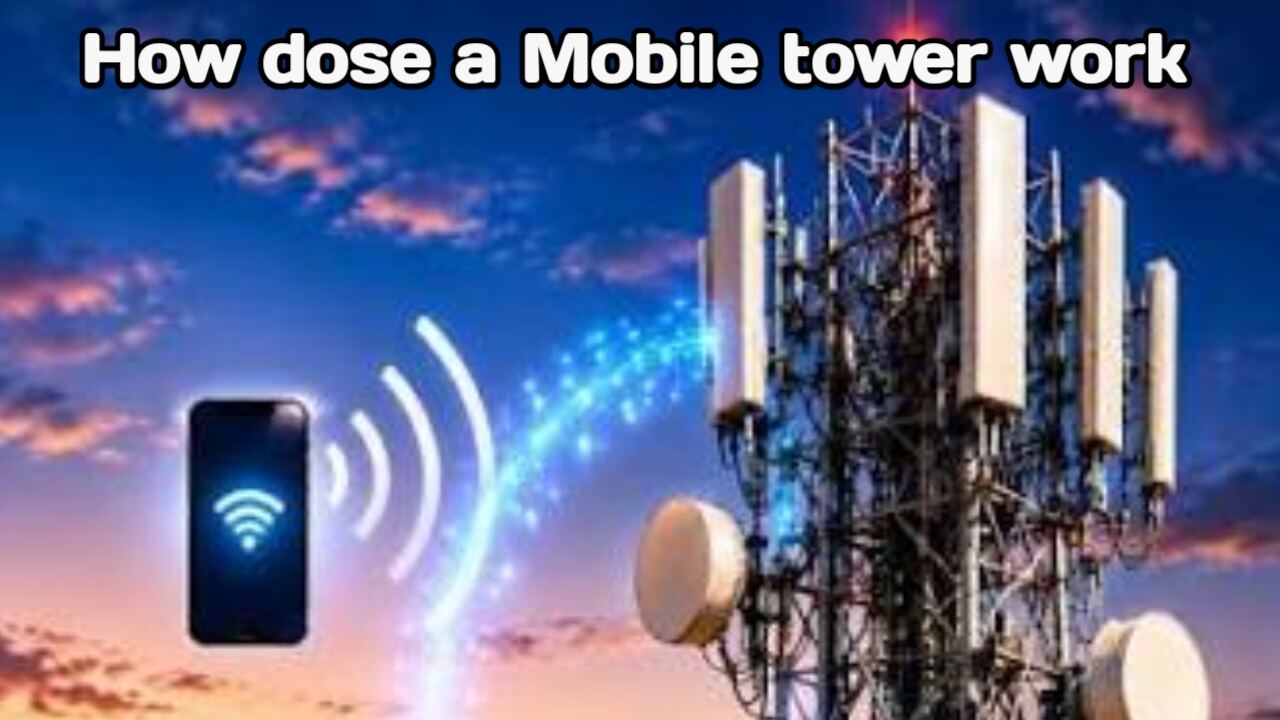
How does a mobile tower work, How does your voice reach another phone
Friends, we spend hours talking on the phone every day. But have you ever stopped to wonder where your voice actually goes? How does the sound from your mouth reach another person’s phone, located kilometers away? What role do those visible mobile towers play in this process?
Why does the voice break up or stutter even when the network signal is full? Why does the signal vanish the moment you step into an elevator or a basement? And how does that tiny SIM card inside your phone tell the network which user is making the call?
Today, we are going to explore the world of mobile communication—a realm where your voice travels from one place to another without any wires.
So, let’s get started.
How did mobile communication begin
Let’s first step back in time. There was a time when talking to someone far away meant using a landline telephone. In those systems, sound traveled from one place to another via copper wires. However, there was a major limitation: making a call was impossible in areas where telephone lines didn’t exist. Later, scientists began to understand radio and electromagnetic waves and started using them for communication. The entire world of mobile communication was eventually built upon the foundation of this technology.
What is the function of a mobile tower
Today, mobile towers are installed at various locations to facilitate mobile communication. Your phone constantly attempts to stay connected to the nearest suitable tower. This is why you can talk on the phone while walking or traveling in a car. The antennas mounted on top of the mobile tower are among its most crucial components; they receive radio signals from your phone and transmit signals back to it. Antennas facing different directions provide network coverage to different areas.
What is inside a mobile tower
Friends, a mobile tower is not just a simple pole. Various electronic systems are installed at its base or in the immediate vicinity. These include radio systems, power supplies, backup power, and other network-related equipment. The function of these systems is to convert digital information into radio signals and vice versa. The baseband unit plays a crucial role in signal processing; various systems handle tasks such as determining the data format, processing the signal, and maintaining timing. Thanks to power backup, the tower can continue to operate for some time even during a power outage.
What happens when you make a call
Let’s say you call a friend. First, your phone scans for signals from nearby mobile towers. It attempts to identify which tower is providing the best and most stable signal. Next, your phone connects to the network. However, simply connecting to the tower is not enough; the network also needs to identify the user operating the phone.
What is the role of the SIM card
The SIM card in your phone holds crucial information linked to your mobile identity, specifically details regarding your unique Subscriber Identity. When the phone connects to the network, the network verifies the SIM’s identity. This process doesn’t simply involve sending a password in the open; instead, an authentication process is used to verify that the information on the SIM and the network matches correctly. Once authentication succeeds, the network recognizes the user as valid and grants permission to access network services.
How does your voice travel from the phone to the tower
When a call connects, your phone’s microphone converts your voice into electrical signals. The phone then transforms your voice into digital data and transmits it to the mobile tower via radio signals. In other words, your voice doesn’t travel through the air in its raw form; instead, it is converted into digital data and transmitted via wireless communication. The tower receives these radio signals and relays them to the mobile operator’s network. The network then determines the destination number or device for the call. A tower near the recipient transmits the necessary signal to your friend’s phone, triggering an incoming call alert.
How do signals work in a mobile network
We have established that a mobile tower is not merely a pole for transmitting signals; it is a comprehensive communication system integrated with power systems, radio systems, and the core network. Now, let’s discuss the signal itself. The signal bars displayed on your phone—whether one, two, or full—serve as a simple indicator of the strength and quality of the surrounding network signal. Your phone continuously monitors nearby network signals to determine which connection offers the best stability. Signal quality is generally better if a tower is nearby and there are few obstructions. Conversely, the signal may weaken if you are inside a building, in a hilly area, or far away from the tower.
Why does the voice break up during a call? Friends, a mobile tower does not transmit your voice directly through the air as sound waves; instead, it communicates using electromagnetic radio signals. When the signal between the phone and the tower weakens or network traffic is high, issues can arise in the proper transmission and reception of data. Some data packets may be affected during transit, and the network attempts to recover or correct them. However, when data packet loss becomes excessive, the other person’s voice may cut out intermittently, or the call might drop completely. Therefore, a poor network is not the only cause of dropped calls; factors such as distance, signal quality, obstructions, network traffic, and other technical conditions can also play a role.
Why is the internet slow even when there is full signal strength
Let’s consider another important point. Often, your phone shows full signal strength, yet the internet runs very slowly or calls take a long time to connect. One reason for this can be network capacity. If too many people are using the network via the same tower simultaneously, the traffic on that tower increases. Every network system has a finite capacity. Therefore, having full signal strength does not always guarantee high internet speeds.
What are the different types of mobile towers
In mobile networks, various types of network sites and towers are used depending on the location and specific requirements. Large towers are commonly seen along highways and in open areas; their purpose is to provide network coverage over a vast area. Additionally, antennas are installed on building rooftops—known as “Rooftop Sites.” There are also “Small Cells,” which are used to boost network coverage and capacity in smaller areas. These can be installed in malls, metro stations, airports, office buildings, and densely populated zones. Small Cells have become particularly important in modern mobile networks.
How does a call switch to another tower while you are moving
Imagine you are talking on the phone while moving. Initially, your phone is connected to a specific tower. However, as you move forward, the signal from that tower may weaken while the signal from another tower becomes stronger. In such a scenario, the network shifts your call from the old tower to the new one. This process is called a “Handover.” If the process executes smoothly, the transition goes unnoticed, and your call continues uninterrupted. However, if the signal is very weak, network traffic is high, or an issue arises during the handover, the call may drop.
The journey from 1G to 4G and 5G
In the early days of mobile networks, 1G systems were primarily used for voice communication. Subsequently, data and internet capabilities expanded alongside the evolution of mobile network generations. Today, 4G and 5G networks focus on enhancing capabilities such as high-speed internet, low latency, and the ability to connect a vast number of devices. In essence, while early mobile networks were primarily used for voice calls, today they serve as the foundation for high-speed internet and a wide range of digital services, in addition to traditional calling.
How does the backbone network behind the tower work
Let us now understand the backbone network that operates behind the mobile tower. The tower communicates with your phone via radio waves; however, fiber optic cables are frequently used to transmit data from the tower to the mobile operator’s core network. In fiber optics, data travels in the form of light pulses, enabling extremely fast communication. In certain remote areas where laying fiber optic connections is challenging, wireless alternatives like microwave links may be employed. These allow data to be transmitted from one tower to another using dish antennas.
Conclusion
So, the next time you pick up your phone to make a call and hear a “hello” on the other end, remember that there is much more to it than simply pressing a button.
The network verifies your identity, your phone converts your voice into digital data, the data reaches the tower via radio signals, and the mobile network facilitates the delivery of that call to the recipient’s phone. A mobile tower is not merely a steel structure; it is backed by an entire communication network that connects millions of people at any given moment. Therefore, when you look at the signal bars on your phone, do not view them as just small lines; the underlying mobile network technology is what connects your phone to the rest of the world.

I am the founder and content creator of SuperJankari.com, a technology-focused website dedicated to sharing useful information about smartphones, laptops, gadgets, apps, software, and the latest technology updates. My goal is to make technology easy to understand by providing clear, practical, and informative content for readers.