How does a CCTV camera work? The full story of the journey from camera to mobile
Right now, as you watch this video, a camera might be watching you. You could be walking down the street, shopping in a store, withdrawing cash from an ATM, or entering an office building. One thing is almost always present everywhere—a CCTV camera. But the most astonishing thing today is that the camera is installed in one location, yet we can view its live feed on our mobile phones from anywhere. Imagine having a camera installed at your home while you are sitting in another city hundreds of kilometers away; you can still see on your mobile screen who is standing outside your house, who is opening the door, or what is happening in your neighborhood.
How is this actually possible
How does the camera’s image reach your mobile phone? Is the camera directly connected to the internet? Where is the video stored? And how does a small camera record every activity, day and night? Have you ever wondered how the police retrieve old footage within just a few hours following a theft, accident, or crime? Where does that footage actually come from? In reality, a CCTV camera does more than just record video; there is a complex system of sensors, digital signals, and technology working behind the scenes. Today, we will explain in simple terms how the camera converts images into video, where that video is stored, and how we can watch the live feed on our mobiles even when the camera is located elsewhere. So, let’s begin by exploring the fascinating technology inside a CCTV camera.
How did CCTV cameras originate
But before understanding how a CCTV camera works, we need to look at its history. To truly understand any technology, it is essential to know why it was created in the first place. If you step out of your home today, you are likely to spot several CCTV cameras within just a few minutes. On the streets, in shops, banks, malls, offices, and even outside many homes. But it wasn’t always this way. There was a time when CCTV cameras did not exist, and surveillance relied entirely on humans. Guards were deployed in large factories; security personnel kept watch around the clock at banks, and people had to maintain constant surveillance at critical locations. However, there was a problem: a human cannot be everywhere at once. People get tired, their attention can wander, and they might miss important events. This created a need for a system capable of monitoring every second, day and night, without fatigue. This concept gave rise to CCTV technology.
What does CCTV stand for
CCTV stands for Closed-Circuit Television. While the name might sound complex, its meaning is quite simple. “Closed-circuit” refers to a system where video signals are transmitted only to specific devices. In other words, the footage captured by the camera isn’t broadcast to the entire world; instead, it is visible only to those connected to that specific system. It is called “television” because it transmits images and video from one location to another. The world’s first CCTV system was created in 1942. At that time, it wasn’t used for security but rather to monitor rocket testing. Scientists wanted to observe rocket launches from a safe distance, so they installed cameras that transmitted video directly to monitors. This marked the inception of CCTV technology. Back then, video recording wasn’t possible; people could only view live footage. Gradually, the technology improved. By the 1960s and 1970s, CCTV systems began to be used in banks, government buildings, and key institutions, though the technology was very expensive at the time. Over time, with the evolution of computers, digital storage, and the internet, CCTV cameras have become far smarter than before. Today, a camera does not merely record; it can store video, transmit it to a mobile phone, and in many instances, even autonomously detect suspicious activity. But the question remains: how exactly does this small camera see? What lies inside it that transforms our world into video? To understand this, we need to take a look inside a CCTV camera.
How does a CCTV camera capture an image
We have learned how CCTV cameras originated, but now the biggest question arises: how exactly does the camera “see”? After all, a camera isn’t a human being; it doesn’t have eyes. So, how does it record every activity happening in front of it? In reality, every CCTV camera contains several key components, the first of which is the lens. The lens’s job is to gather light coming from the scene. When you stand in front of a camera, light strikes your body and reflects back toward the camera, entering through the lens. However, merely gathering light isn’t enough. Just as our eyes have a retina, a camera has an image sensor. When the lens focuses light onto the sensor, the sensor detects that light. Yet, the sensor doesn’t “see” an image the way we do; it simply distinguishes between areas of high and low light intensity. The sensor consists of millions of tiny pixels, each measuring the light that falls upon it. This information is then transmitted to the camera’s processor. This is where the processor takes over, converting these signals into digital data—effectively translating the scene before the camera into computer language.
How is a video created from images
But one question remains.
If a camera only captures still images, how is a video created
In truth, video isn’t magic; it is simply a collection of thousands of images. A CCTV camera captures approximately 25 to 30 images every second. These images are known as “frames.” When these frames are displayed in rapid succession, our eyes perceive continuous motion, and this sequence of moving images is what we call a video. For instance, if a person is walking in front of the camera, the camera captures multiple images of them every second: in the first image, they are slightly further back; in the second, a bit further forward; and in the third, even further ahead. When these images are played in rapid succession, the person appears to be moving. This same principle is used in movies, television, and mobile videos.
Where is CCTV video stored
Now, a new issue arises: the camera has captured the video, but where will it be safely stored? After all, if the recording isn’t saved, there is no point in reviewing the footage later.
So, where does the video from the camera actually go, and what role do devices known as DVRs and NVRs play in this process?
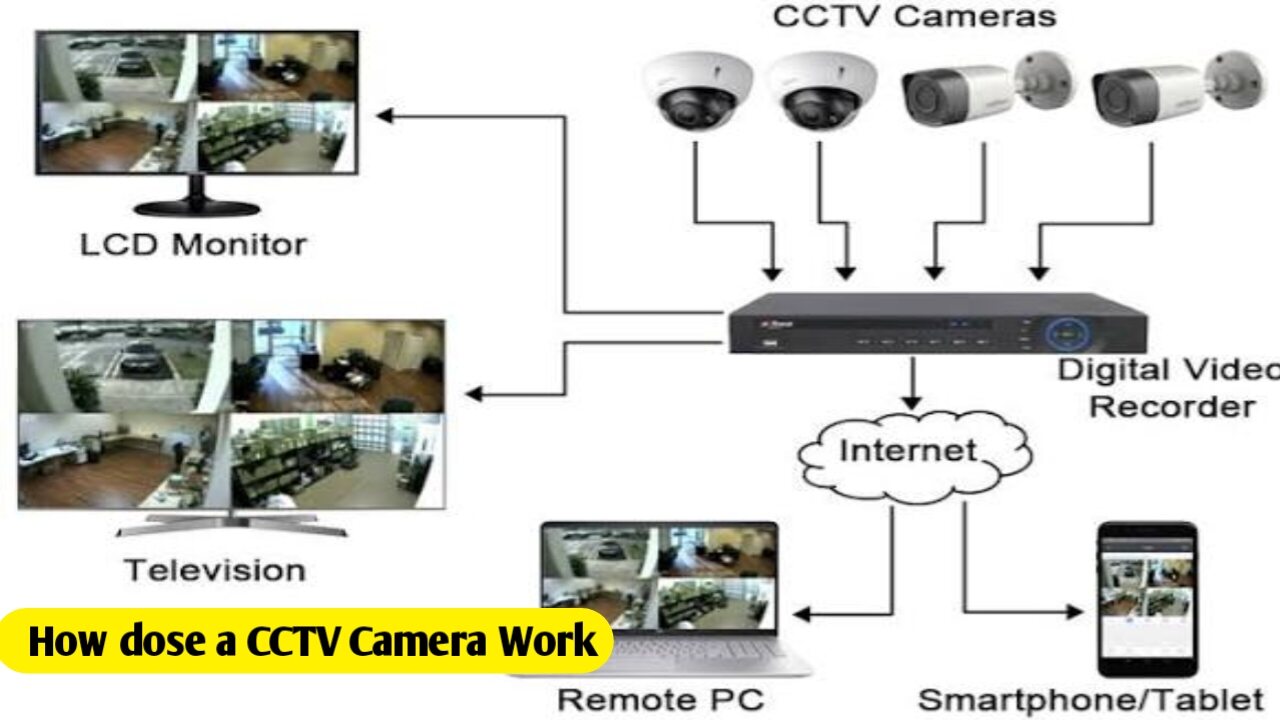
Let’s understand this. In older CCTV systems, the camera was connected directly to a device called a DVR (Digital Video Recorder). The video captured by the camera travels via cable to the DVR. The DVR receives the video, processes it, and stores it on a hard disk—much like how your files are saved on a computer’s hard drive.
What is an NVR
A new technology known as NVR—or Network Video Recorder—has recently become quite popular. While DVRs and NVRs share a similar purpose, their operating methods differ slightly. DVRs primarily work with analog cameras, whereas NVRs work with modern IP cameras. An IP camera converts the video into a digital format itself and transmits it to the NVR over a network. The use of NVRs is rapidly increasing in modern CCTV systems.
How much storage does CCTV video require
Consider the volume of video accumulated if a camera records continuously, day and night. A single day can generate gigabytes of data, and the storage requirement increases further when multiple cameras are installed. That is why high-capacity hard disks are used; in many locations, hard disks with capacities of 1 TB, 2 TB, 4 TB, or even larger are employed. However, hard disks still have their limits. It cannot store recordings indefinitely.
So, what happens when the hard disk fills up? Does the camera stop recording
No. Most CCTV systems use loop recording. This means that when the hard disk becomes full, the system begins deleting the oldest recordings to make room for new ones. In other words, the camera records continuously, and storage is managed automatically.
How is old CCTV footage located
Suppose a theft occurred at a shop a week ago. How would the owner find that specific incident amidst so much video footage? DVRs and NVRs offer a search feature based on date and time. You simply select the date and time, and the system instantly displays the footage from that moment. This is why police or investigative agencies can quickly retrieve CCTV footage after an incident. However, there is an interesting twist to the story. Previously, one had to go to the DVR or monitor to view CCTV footage, but today, the camera feed can be accessed right on your mobile phone.
How can you view live CCTV camera footage on your mobile
We have established that CCTV cameras capture video and DVRs or NVRs store it. But the most remarkable thing today is that a camera installed at your home can be viewed live on your mobile from anywhere—whether you are at the office, in another city, or even in another country. You simply take out your mobile, open the app, and the live camera feed appears right before you.
But how exactly does this work
Does the camera connect directly to your mobile phone? No. Internet and networking technologies play a crucial role in this process. In fact, most modern CCTV cameras are connected to the internet; either the camera connects directly via Wi-Fi, or the DVR/NVR is linked to an internet router. When the camera records video, the footage isn’t just saved to a hard drive; it can also be transmitted to your mobile phone via the internet and a server. The server acts as an intermediary, establishing a connection between the camera and your mobile. When you open the CCTV app on your phone, it connects to the server, which then relays the camera’s live video feed to your device. This is why you can monitor your home, shop, or office in real-time, even from thousands of kilometers away.
How does a CCTV camera send notifications to your mobile
However, viewing live video isn’t the only capability. If activity occurs in front of the camera, many modern models can instantly send a notification to your mobile phone. For instance, if someone approaches your home’s main entrance, the camera can detect the motion and send an alert to your phone within seconds. This means you don’t need to constantly watch the camera feed; the camera itself can notify you of significant activities. So, the next time you spot a CCTV camera outside a street, shop, or office, remember that the small device does more than just record video. Behind the scenes, components like the lens, image sensor, processor, storage, and network technologies work in unison to make it all happen.
Conclusion
A CCTV camera is not merely a small device for recording video; rather, it relies on the integrated functioning of various technologies such as lenses, image sensors, processors, DVRs/NVRs, hard disks, the internet, and networking. The camera converts light into digital data using the sensor, the DVR/NVR stores the video, and the live feed can be accessed on a mobile device via the internet. This entire process enables us to monitor our homes, shops, or offices from a distance and review past footage whenever necessary.

I am the founder and content creator of SuperJankari.com, a technology-focused website dedicated to sharing useful information about smartphones, laptops, gadgets, apps, software, and the latest technology updates. My goal is to make technology easy to understand by providing clear, practical, and informative content for readers.