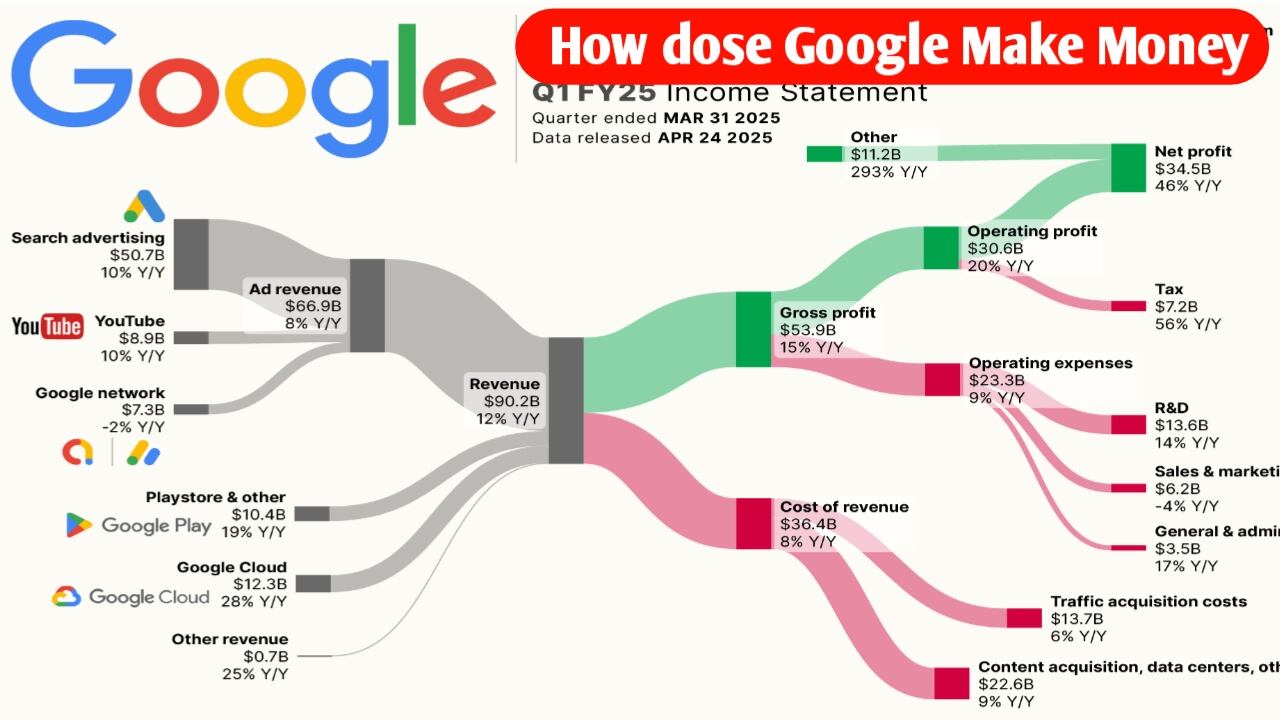
How does Google make money? From Search to YouTube and Google Cloud
There is a company that doesn’t charge a single rupee for its biggest service—Search. It offers services like Gmail, Maps, and YouTube for free, yet it earns lakhs of rupees every second. How? The answer lies in an auction that you never actually see. Every time you search for something on Google, an invisible auction begins. In just a few hundred milliseconds—before your screen even finishes loading—it is decided which ad you will see and how much the company will earn from it. But the most surprising part is that the advertiser who bids the highest amount doesn’t always win the auction. So, who wins? Today, we will understand the real engine behind Google—the one that generates revenue from every click, every search, and every video view. We’ll look beyond just the story to the entire technical system: the auctions, the commissions, and how it all fits together. We will walk through the entire process step-by-step.
Where does the money come from if Google’s services are free?
First, we need to answer a fundamental question.
If Search is free and Gmail is free, where does the money come from
The answer might sound a bit unusual. You don’t pay Google, but you aren’t its product either. The truth is that your data—what you search for, which videos you watch—is exactly what advertisers want. To understand this, imagine a typical shop. A shopkeeper distributes free samples of a new product. They know the sample itself won’t generate direct revenue, but the crowd drawn by the sample makes other brands willing to pay to stock their own goods in that shop. Google does the same thing. Search, Gmail, Maps, and YouTube are all free samples designed to draw people from around the world to Google every single day. This is where a cycle begins—what can be called the “Data Flywheel.” The more users there are, the more data is gathered; this allows for more accurate predictions of your preferences and enables the display of highly targeted ads—for which advertisers are willing to pay a premium. This cycle repeats, growing larger with each iteration.
Who is Google’s actual customer
So, who is the real customer? It isn’t you. It is the millions of companies that want to show you their ads.
But how do these advertisers pay?
Is there a deal based on a fixed rate?
No. And that is where the auction comes in.
How does the ad auction work on Google Search
Imagine that, at any given moment, thousands of companies selling various products are lining up. Everyone wants their ad to appear at the very top. Google instantly runs a unique auction just for you. This is no ordinary auction; the entire process concludes in a matter of milliseconds—faster than the blink of an eye.
In that split second, Google makes three decisions:
- Which ad will be shown?
- In what order will it appear?
- How much does the advertiser have to pay for each click?
Does the highest-paying ad always win
The question arises: does the advertiser willing to pay the most always win? The answer is—no. If money alone determined the winner, a large company would always stay at the top, regardless of how poor its ad might be. Furthermore, people would get annoyed by irrelevant ads and use Google less. That is why Google created a formula known as “Ad Rank.”
What is Ad Rank
Ad Rank is primarily determined by two factors. First, the advertiser’s bid—that is, the amount they are willing to pay for each click. Second, their Quality Score—the actual quality of the ad.
Simply put:
Ad Rank = Bid × Quality Score
Quality Score evaluates three things:
- How many people are actually likely to click on this ad?
- How well does the ad text match the search?
- How useful is the page you will reach after clicking?
So, if an advertiser places a bid of ₹15 and has a Quality Score of just 3, their Ad Rank becomes 45. Another advertiser places a bid of only ₹8 but has a Quality Score of 8, resulting in an Ad Rank of 64. In other words, the advertiser who is more relevant—even with a lower bid—comes out ahead. Think of it like a classroom: marks aren’t awarded simply to the child who raises their hand the loudest, but to the one who gives the correct answer.
Does the advertiser pay their full bid amount
But does the advertiser who wins this race actually pay their full bid? That is the most unique aspect of this system. Google runs a “Modified Second-Price Auction.” This means the winning advertiser doesn’t pay their actual bid amount; instead, they pay just enough to surpass the runner-up—specifically, a little bit more than what was required to beat that second-place score. Let’s revisit the previous example: your bid was ₹8 and your Ad Rank was 64, while the runner-up’s Ad Rank was only 45. You only need to pay enough to push your Ad Rank slightly above 45—not the full ₹8. Consequently, the actual cost can often be lower than your maximum bid. This is why Google consistently advises advertisers: don’t just raise your bid; improve ad relevance and the landing page, and you’ll naturally save money.
How much does Google earn from Search
This auction process, the Ad Rank formula, and the second-price logic form the true engine behind Google Search’s advertising revenue. It accounts for the largest share of Google’s total earnings—more than half, in fact. But does Google play this game only on its own websites?
No.
Google’s Advertising Network
Google has a network, too. This same Ad Rank logic applies across millions of other websites and apps as well. The same logic applies to YouTube as well. Whenever you see an ad before or during a video, advertisers place bids in a similar fashion. The same concepts—like Ad Rank and auction-style mechanisms—are at play. The only difference is that instead of a search query, your watch history and content preferences drive the process. Advertisers are willing to pay for YouTube because users spend hours there, not just a few seconds. This is why advertising revenue from the Search Network and YouTube combined accounts for the largest share of Google’s earnings.
Does Google’s entire revenue come solely from ads?
No. Another engine is growing rapidly: Google Cloud. To understand this, consider that if your home needs electricity, you don’t build your own power plant; you source power from a utility company and pay only for what you use. Similarly, if a large company requires massive computing power, storage, or AI processing capabilities, it doesn’t build its own data center. Instead, it rents these resources from Google Cloud and pays a consumption-based fee—meaning you pay only for what you use. Nowadays, every major company needs immense computing power to run AI models, which is why Google Cloud has become a rapidly growing segment of Google’s business.
How does Google earn from the Play Store
Finally, there is one last component—the area where you pay directly from your own pocket. Whenever you purchase a paid app, sign up for a subscription, or make an in-app purchase within a game on the Android Play Store, Google takes a share as a commission. This is typically around 20%—slightly lower for subscriptions and slightly higher for digital goods. In essence, a portion of the earnings generated by millions of developers worldwide goes directly to Google, without the company having to create a new product itself.
Google’s revenue engine
So, you now understand that Google doesn’t rely on just one source of income; it operates as a comprehensive revenue-generating machine. The invisible auction, Ad Rank formula, second-price logic, and commission system—all working together. Combined, these elements create a system that generates revenue from every second, every click, and every video view. This is the very machine that has made Google one of the highest-earning technology companies in the world.
Conclusion
Google’s revenue does not rely on a single service. Advertising on Search and YouTube—along with ad rank and auction systems, Google Cloud services, and Play Store commissions—collectively form its revenue model. Users access many services for free, yet advertising and other business models operate behind the scenes. It is the combination of these various systems that transforms Google into a massive digital revenue-generating machine.

I am the founder and content creator of SuperJankari.com, a technology-focused website dedicated to sharing useful information about smartphones, laptops, gadgets, apps, software, and the latest technology updates. My goal is to make technology easy to understand by providing clear, practical, and informative content for readers.